ND Upgrade - Personal
  • Tell My Loved Ones
  • Our Toolbox
  • Interpersonal 🚧
Neurodivergent Upgrade

On this page

  • Depression or Internalized Ableism?
  • Resenting Privilege
  • You’re Not Bad With People

Self-Concept

… challenging the stories we tell ourselves

Many neurominorities struggle with mental health challenges and feelings of inadequacy. It’s important to understand the burden we carry so that we can level up past harmful and incorrect relationships to our neuroqueerness.

Depression or Internalized Ableism?
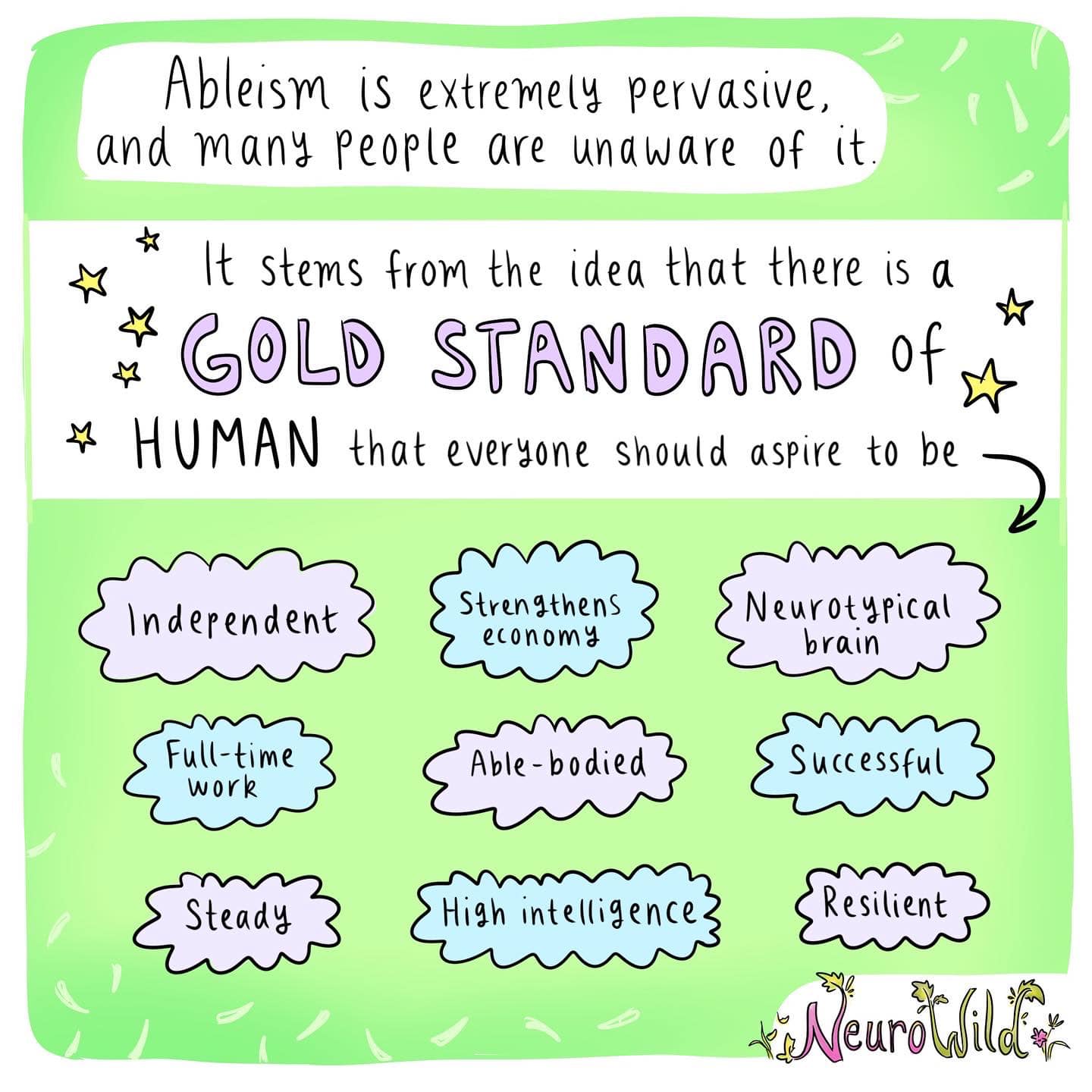
Ableism comic, panel 3, on a green background with yellow stars. Top: 'Ableism is extremely pervasive, and many people are unaware of it.' Then: 'It stems from the idea that there is a GOLD STANDARD of HUMAN that everyone should aspire to be' with an arrow down to nine cloud shapes: Independent, Strengthens economy, Neurotypical brain, Full-time work, Able-bodied, Successful, Steady, High intelligence, Resilient. The NeuroWild logo is at the bottom right.

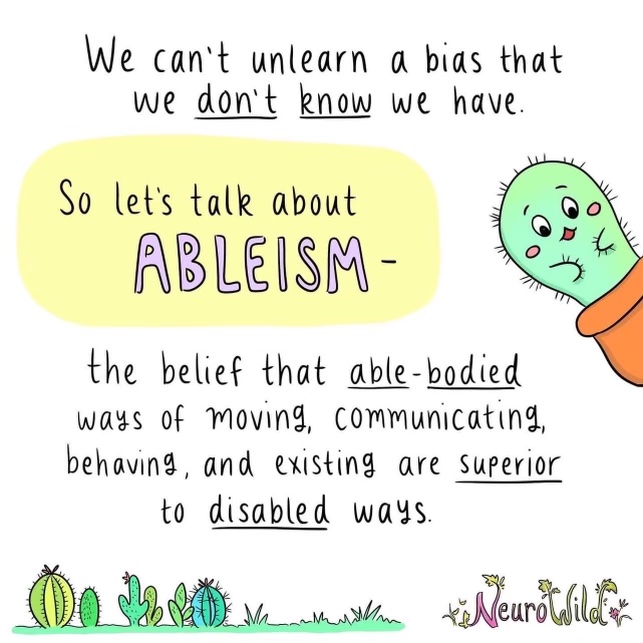
Ableism comic, panel 1. Text: 'We can't unlearn a bias that we don't know we have.' A yellow blob reads 'So let's talk about ABLEISM -' in large purple letters, followed by 'the belief that able-bodied ways of moving, communicating, behaving, and existing are superior to disabled ways.' A green cartoon cactus with a worried face in an orange pot peeks in from the right. Small cacti and grass run along the bottom. The NeuroWild logo is at the bottom right.

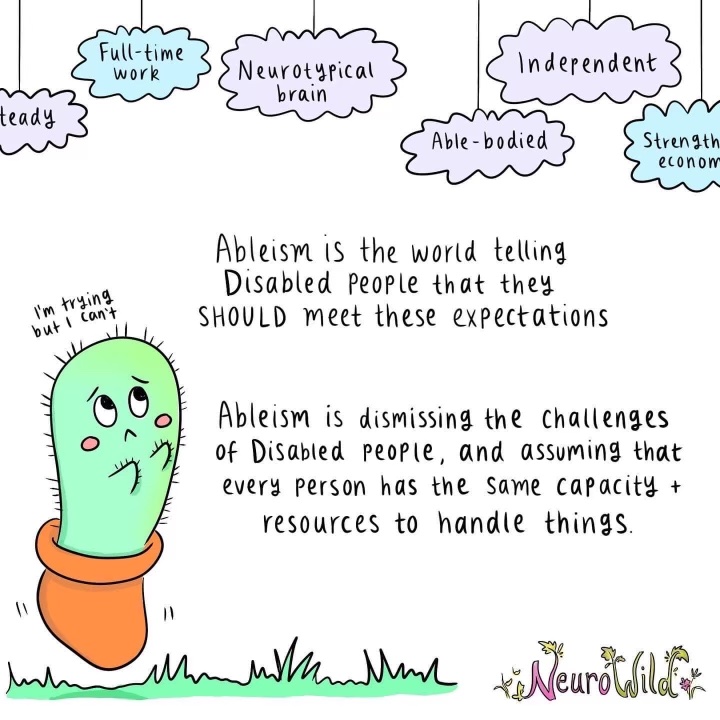
Ableism comic, panel 2. Hanging cloud shapes across the top read 'Steady' (partly cut off), 'Full-time work', 'Neurotypical brain', 'Independent', 'Able-bodied', and 'Strength... econom...' (cut off at the edge). Text: 'Ableism is the world telling Disabled people that they SHOULD meet these expectations'. A worried green cactus in an orange pot, small text 'I'm trying but I can't', is at lower left. Text: 'Ableism is dismissing the challenges of Disabled people, and assuming that every person has the same capacity + resources to handle things.' The NeuroWild logo is at the bottom right.

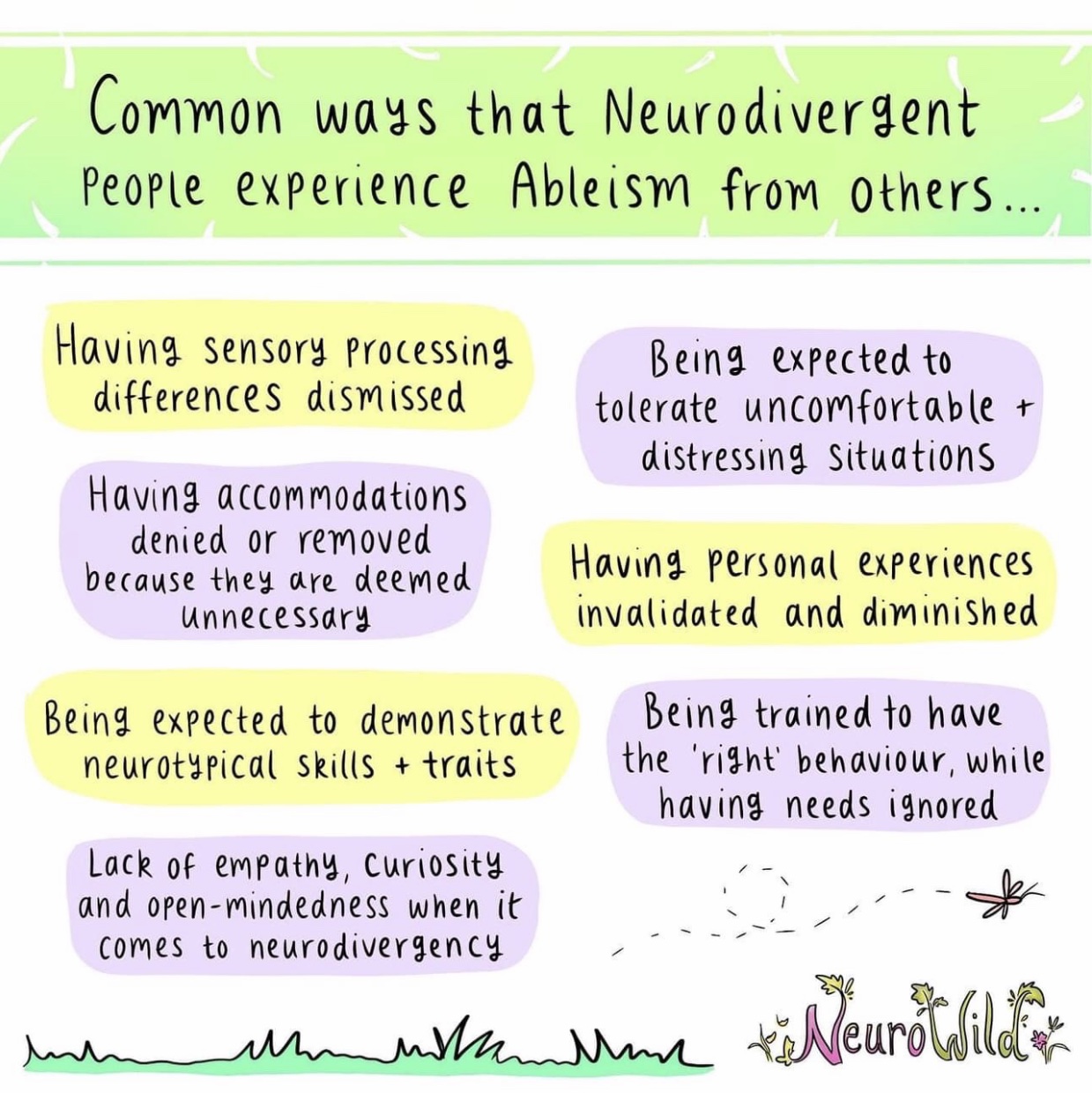
Ableism comic, panel 4, with a green header. Title: 'Common ways that Neurodivergent People experience Ableism from others...' Colored blobs read: 'Having sensory processing differences dismissed'; 'Being expected to tolerate uncomfortable + distressing situations'; 'Having accommodations denied or removed because they are deemed unnecessary'; 'Having personal experiences invalidated and diminished'; 'Being expected to demonstrate neurotypical skills + traits'; 'Being trained to have the 'right' behaviour, while having needs ignored'; 'Lack of empathy, curiosity and open-mindedness when it comes to neurodivergency'. A small pink dragonfly and grass decorate the bottom. The NeuroWild logo is at the bottom right.

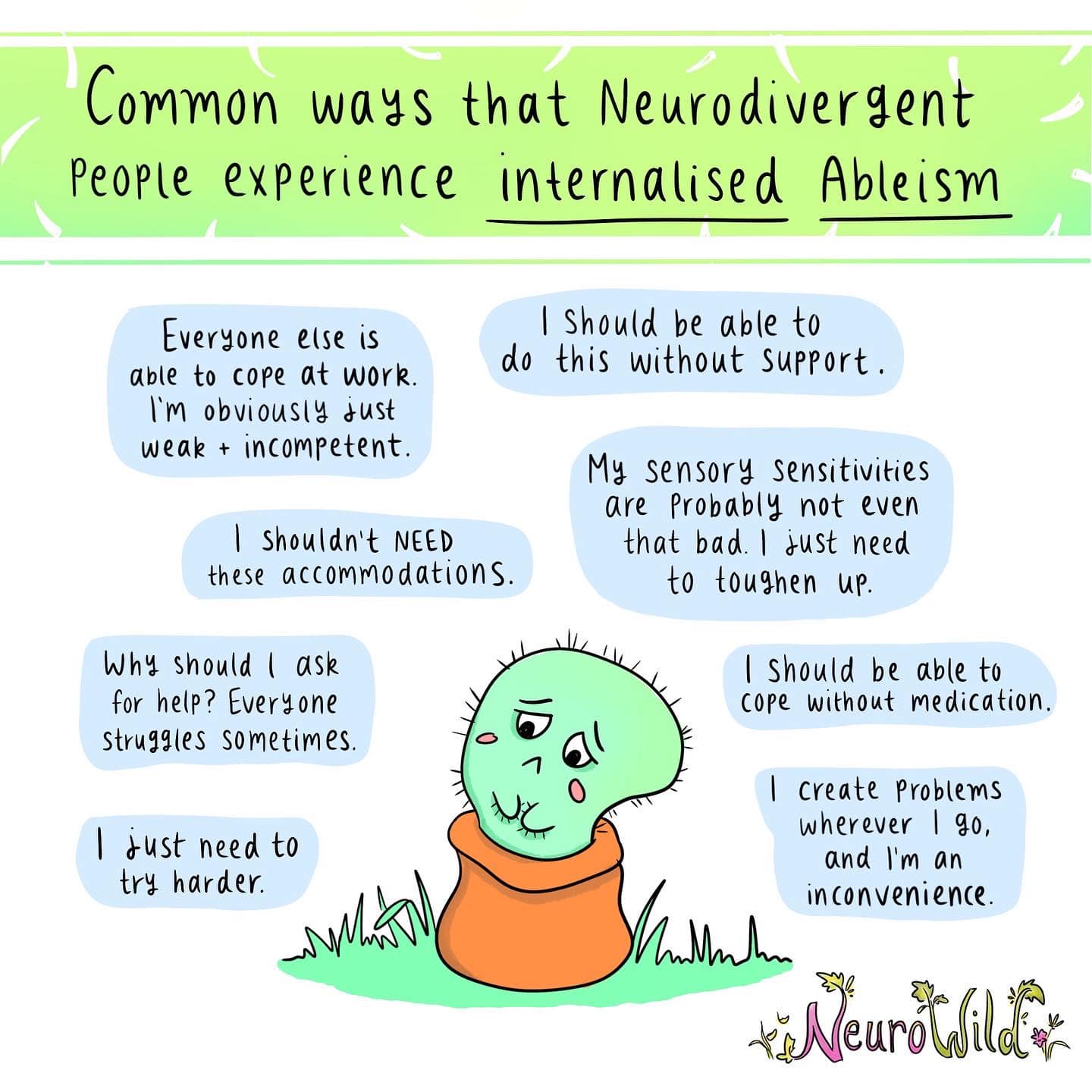
Illustration on a white background with a light green header. The header reads 'Common ways that Neurodivergent People experience internalised Ableism', with 'internalised' and 'Ableism' underlined. A small sad green cactus in an orange pot sits in the center, surrounded by eight light blue speech bubbles: 'Everyone else is able to cope at work. I'm obviously just weak + incompetent.'; 'I should be able to do this without support.'; 'I shouldn't NEED these accommodations.'; 'My sensory sensitivities are probably not even that bad. I just need to toughen up.'; 'Why should I ask for help? Everyone struggles sometimes.'; 'I should be able to cope without medication.'; 'I just need to try harder.'; 'I create problems wherever I go, and I'm an inconvenience.' The 'NeuroWild' logo is at the bottom right.

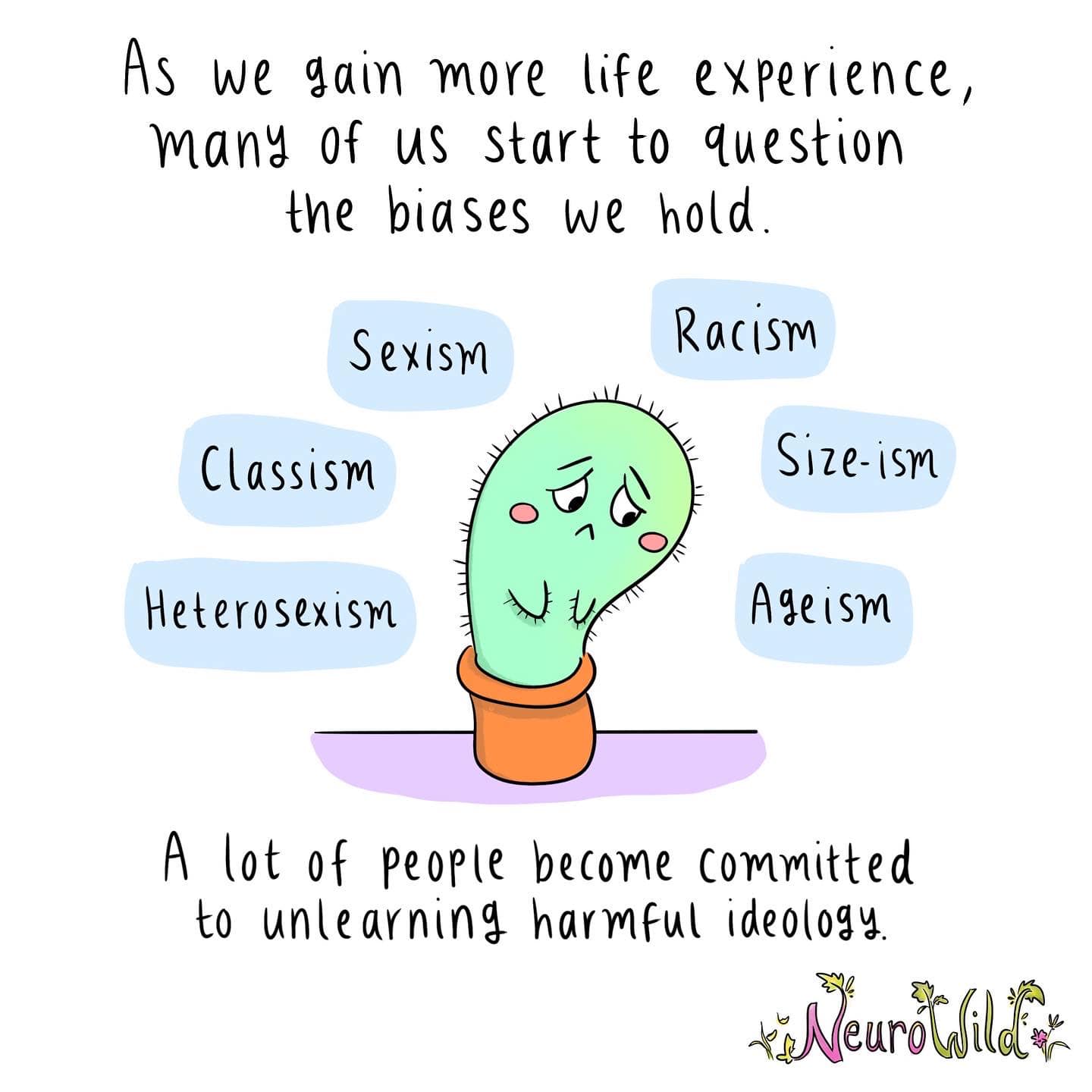
Illustration with a white background. Top text: 'As we gain more life experience, many of us start to question the biases we hold.' A worried green cactus with pink cheeks stands in an orange pot, surrounded by six light blue bubbles: 'Sexism', 'Racism', 'Classism', 'Size-ism', 'Heterosexism', 'Ageism'. Bottom text: 'A lot of people become committed to unlearning harmful ideology.' The 'NeuroWild' logo is at the bottom right.

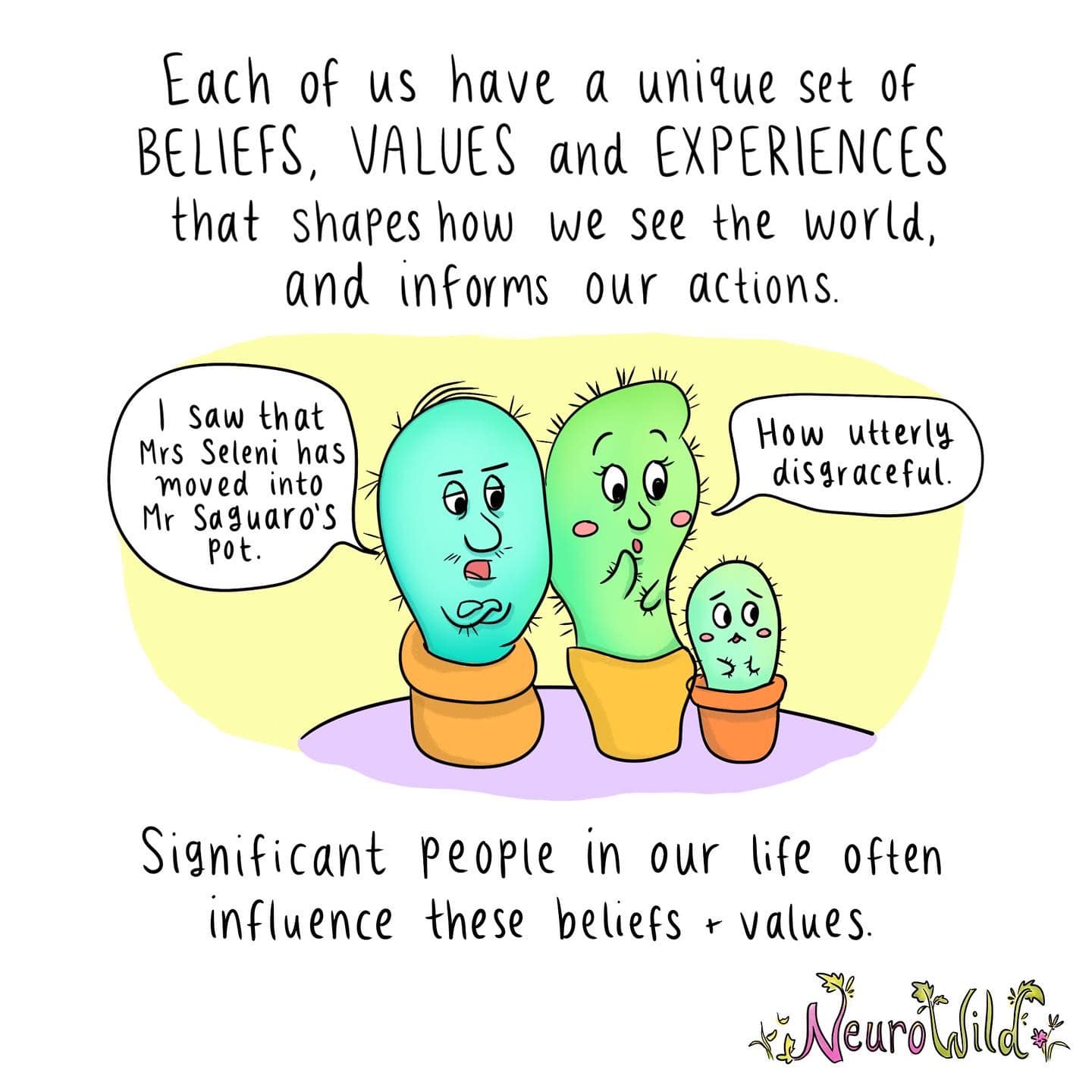
Illustration with a white background. Top text: 'Each of us have a unique set of BELIEFS, VALUES and EXPERIENCES that shapes how we see the world, and informs our actions.' A yellow oval scene shows two adult cacti in pots and a small cactus child in a small pot. The teal adult on the left says 'I saw that Mrs Seleni has moved into Mr Saguaro's pot.' The green adult in the middle, hand to her mouth, says 'How utterly disgraceful.' The small cactus looks worried. Bottom text: 'Significant people in our life often influence these beliefs + values.' The 'NeuroWild' logo is at the bottom right.

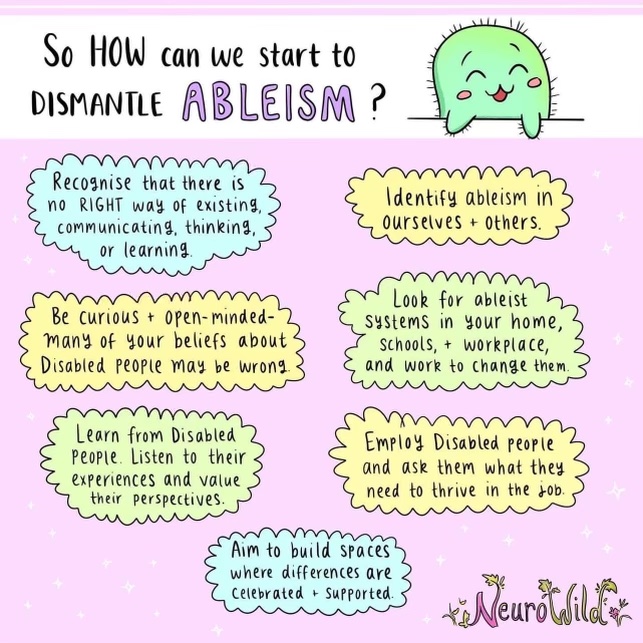
Ableism comic, panel 5, on a pink background with a smiling green cactus peeking over a ledge at the top right. Title: 'So HOW can we start to DISMANTLE ABLEISM?' Seven cloud-shaped boxes read: 'Recognise that there is no RIGHT way of existing, communicating, thinking, or learning.'; 'Identify ableism in ourselves + others.'; 'Be curious + open-minded- many of your beliefs about Disabled people may be wrong.'; 'Look for ableist systems in your home, schools, + workplace, and work to change them.'; 'Learn from Disabled people. Listen to their experiences and value their perspectives.'; 'Employ Disabled people and ask them what they need to thrive in the job.'; 'Aim to build spaces where differences are celebrated + supported.' The NeuroWild logo is at the bottom right.

Resenting Privilege

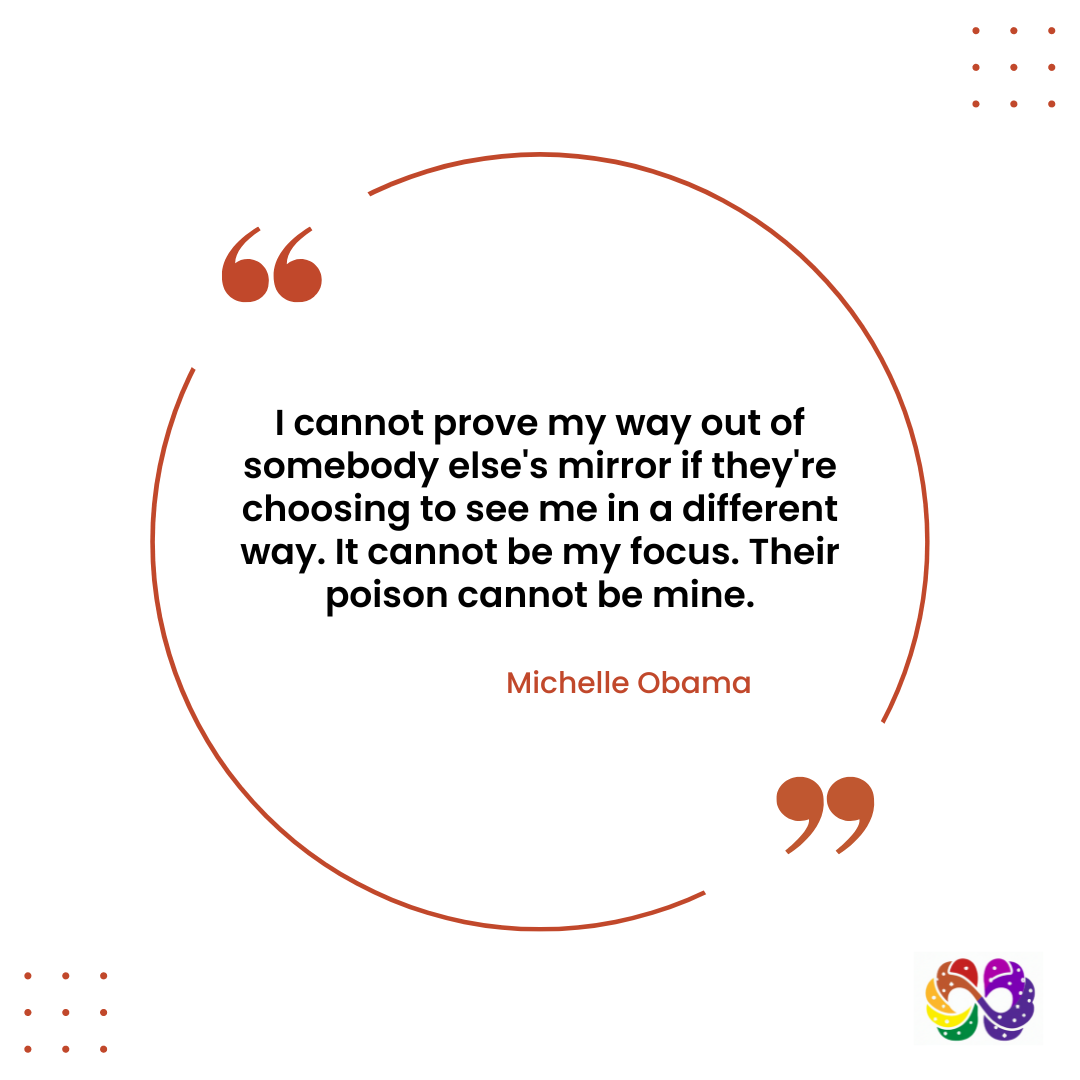
Michelle Obama Quote. I cannot prove my way out of somebody else's mirror if they're choosing to see me in a different way. It cannot be my focus. Their poison cannot be mine.

Different strategies work for different people. If one is ineffective, stop pursuing it. If these are both ineffective, do not assume the literature for navigating hardship is finished being written and try finding your own or speaking to someone who is better at self-introspection (in order to help you).

What matters most is being open to having a self-concept which, when applied, suits your ability to make progress on achieving your goals. Changing your relationship with understanding the world to suit the next stage of your life experience is part of growing as an adult. If your resentment is part of an untreated soul wound or moral injury, judging and dismissing oneself and others for feeling a certain way is unlikely to help anyone change and achieve relief.

  • If you are not making philosophy in this area your profession, it does not matter which worldview is “right” because you are not equipped to vet the philosophical inconsistencies.
  • Being a person means evolving with different epochs in your life. Focusing on getting a worldview “right” rather than using what works and fits distracts you from living in the present and keeps you inflexible, closed to others and new experiences.
  • You can only do so much in one lifetime, and pushing away strategies which:
    1. … fit.
    2. … help you change and nevertheless but feels logically “flawed” may a sign that you are rooted in a deeper negativity bias or resistance to self-growth that you are either A. not trained to spot or 2. do not have the introspective capacity at the time to spot.
  • Use the worldview that works for you continuing to act in your own best interest and allows you to feel better, whatever that is.
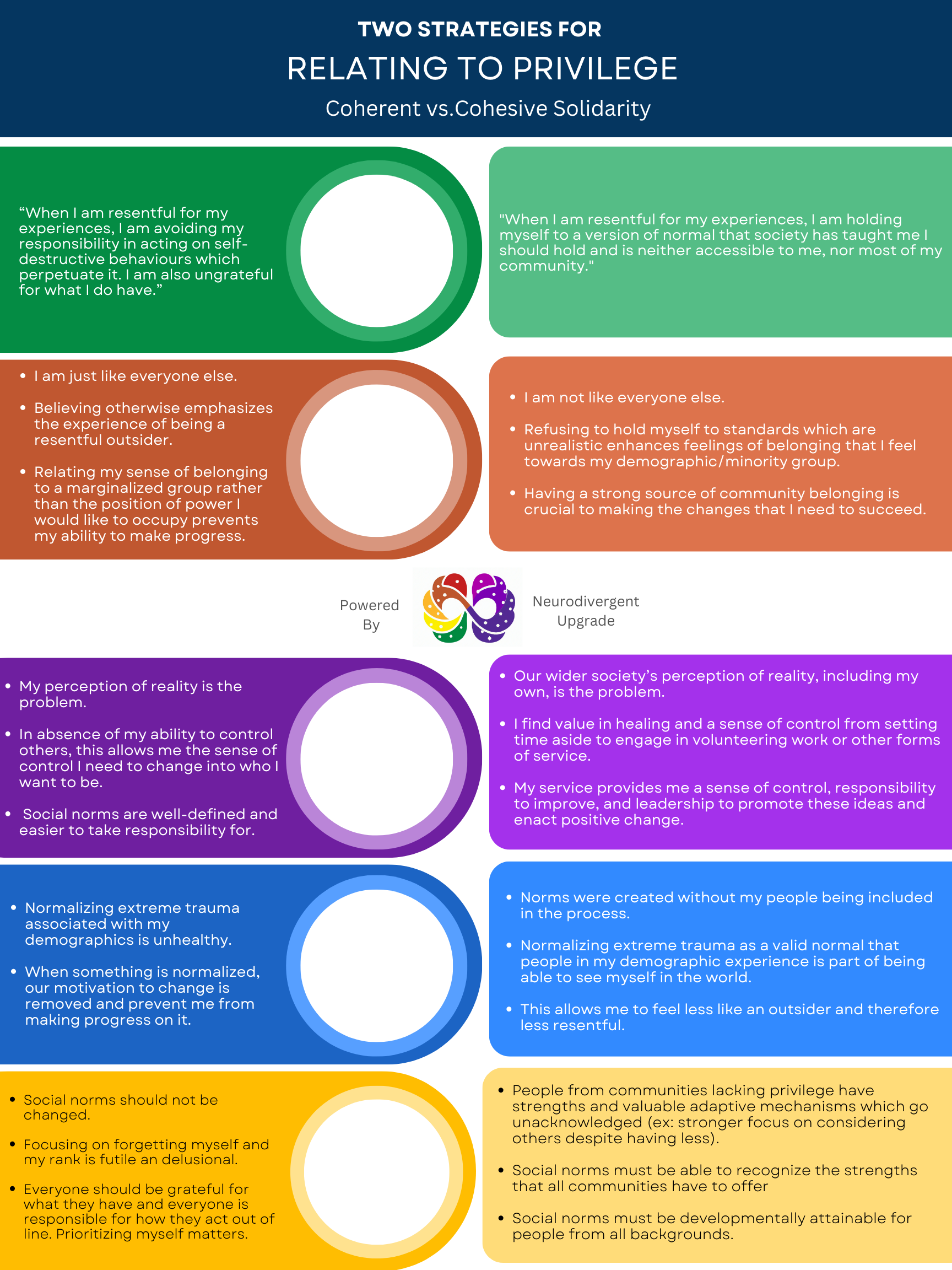
Infographic with a navy header: 'TWO STRATEGIES FOR RELATING TO PRIVILEGE', subtitle 'Coherent vs.Cohesive Solidarity'. Five rows, each pairing a colored box in the left column with one in the right column, with a rainbow infinity brain logo reading 'Powered By Neurodivergent Upgrade' between rows 2 and 3. Row 1 (green) left: 'When I am resentful for my experiences, I am avoiding my responsibility in acting on self-destructive behaviours which perpetuate it. I am also ungrateful for what I do have.' Right: 'When I am resentful for my experiences, I am holding myself to a version of normal that society has taught me I should hold and is neither accessible to me, nor most of my community.' Row 2 (orange) left: 'I am just like everyone else.'; 'Believing otherwise emphasizes the experience of being a resentful outsider.'; 'Relating my sense of belonging to a marginalized group rather than the position of power I would like to occupy prevents my ability to make progress.' Right: 'I am not like everyone else.'; 'Refusing to hold myself to standards which are unrealistic enhances feelings of belonging that I feel towards my demographic/minority group.'; 'Having a strong source of community belonging is crucial to making the changes that I need to succeed.' Row 3 (purple) left: 'My perception of reality is the problem.'; 'In absence of my ability to control others, this allows me the sense of control I need to change into who I want to be.'; 'Social norms are well-defined and easier to take responsibility for.' Right: 'Our wider society's perception of reality, including my own, is the problem.'; 'I find value in healing and a sense of control from setting time aside to engage in volunteering work or other forms of service.'; 'My service provides me a sense of control, responsibility to improve, and leadership to promote these ideas and enact positive change.' Row 4 (blue) left: 'Normalizing extreme trauma associated with my demographics is unhealthy.'; 'When something is normalized, our motivation to change is removed and prevent me from making progress on it.' Right: 'Norms were created without my people being included in the process.'; 'Normalizing extreme trauma as a valid normal that people in my demographic experience is part of being able to see myself in the world.'; 'This allows me to feel less like an outsider and therefore less resentful.' Row 5 (yellow) left: 'Social norms should not be changed.'; 'Focusing on forgetting myself and my rank is futile an delusional.'; 'Everyone should be grateful for what they have and everyone is responsible for how they act out of line. Prioritizing myself matters.' Right: 'People from communities lacking privilege have strengths and valuable adaptive mechanisms which go unacknowledged (ex: stronger focus on considering others despite having less).'; 'Social norms must be able to recognize the strengths that all communities have to offer'; 'Social norms must be developmentally attainable for people from all backgrounds.'

You’re Not Bad With People

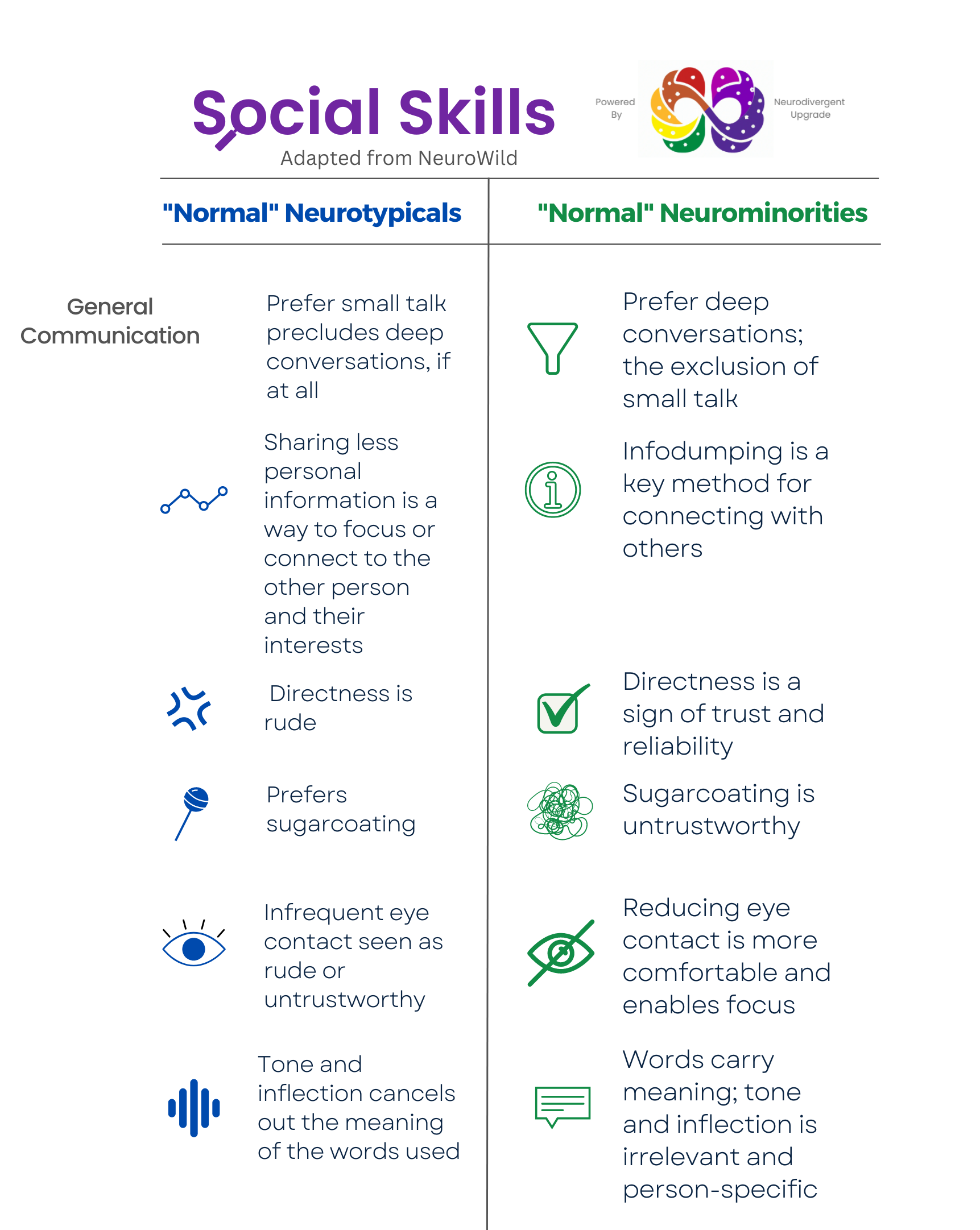
Infographic titled 'Social Skills', with a purple title in a magnifying-glass style, the subtitle 'Adapted from NeuroWild', and a small rainbow infinity-brain logo labeled 'Powered By Neurodivergent Upgrade'. A vertical line splits two columns: blue 'Normal' Neurotypicals on the left and green 'Normal' Neurominorities on the right, each row with a small icon. Row group label 'General Communication'. Rows, left then right: 'Prefer small talk precludes deep conversations, if at all' versus 'Prefer deep conversations; the exclusion of small talk' (funnel icon). 'Sharing less personal information is a way to focus or connect to the other person and their interests' versus 'Infodumping is a key method for connecting with others' (info icon). 'Directness is rude' versus 'Directness is a sign of trust and reliability' (checkmark icon). 'Prefers sugarcoating' (lollipop icon) versus 'Sugarcoating is untrustworthy' (tangled scribble icon). 'Infrequent eye contact seen as rude or untrustworthy' (open eye) versus 'Reducing eye contact is more comfortable and enables focus' (crossed-out eye). 'Tone and inflection cancels out the meaning of the words used' (sound wave icon) versus 'Words carry meaning; tone and inflection is irrelevant and person-specific' (speech bubble icon).

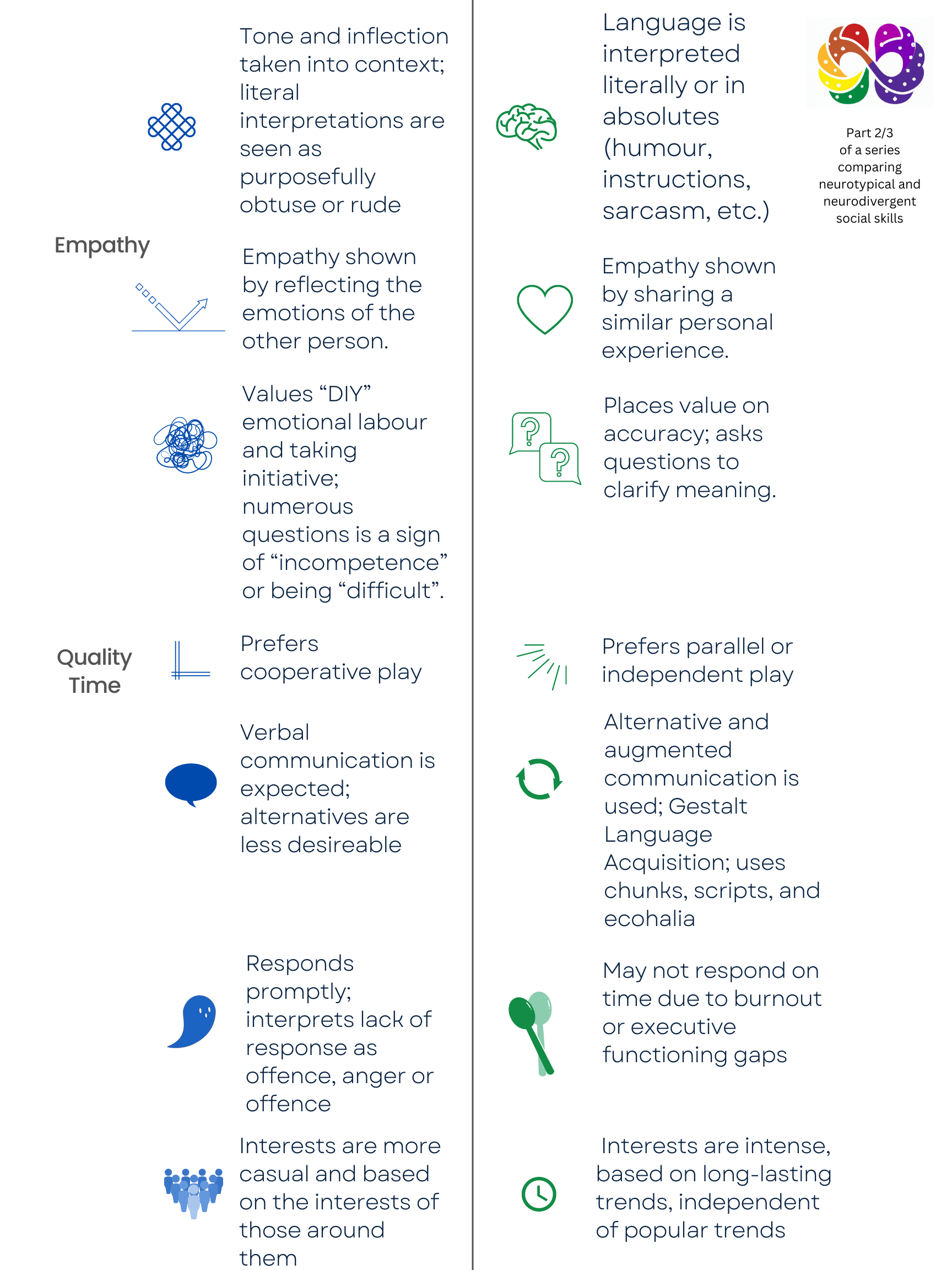
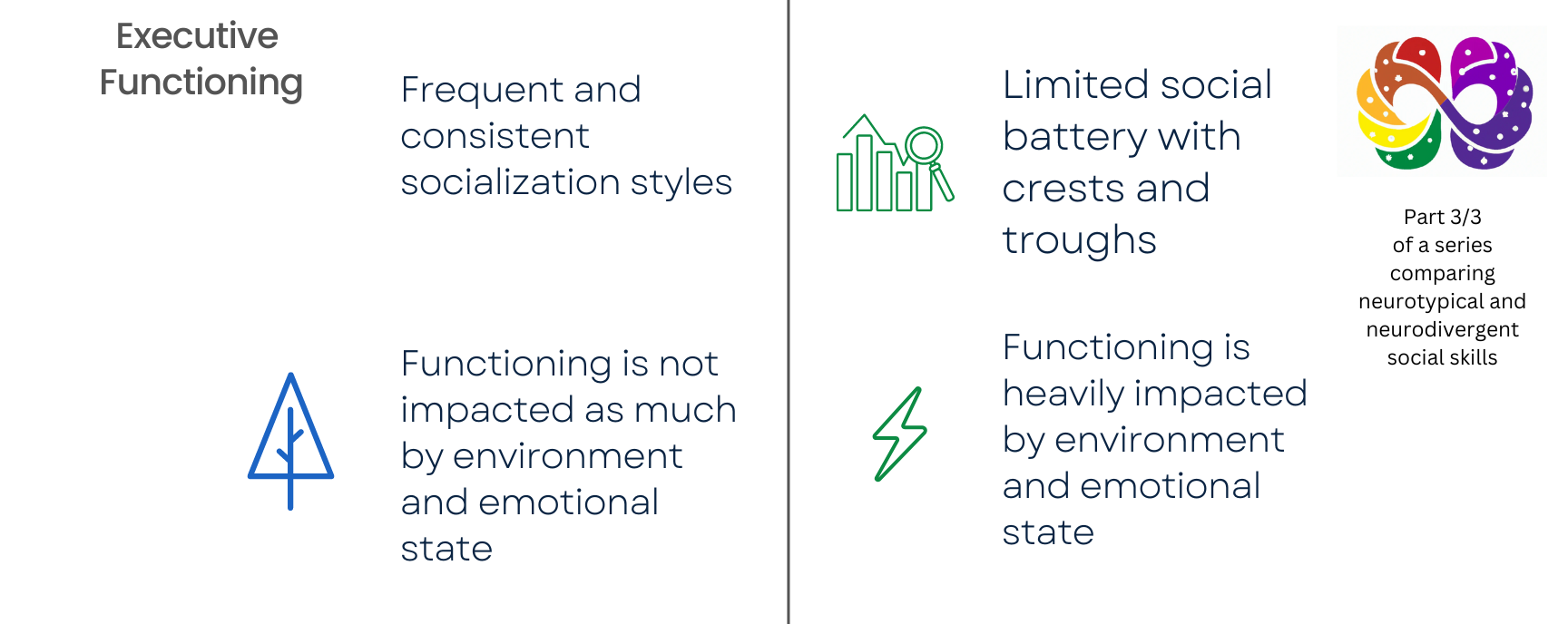
Second part of the Social Skills comparison infographic, with the left column in blue for neurotypicals and the right column in green for neurominorities. A small rainbow infinity-brain logo at top right is captioned 'Part 2/3 of a series comparing neurotypical and neurodivergent social skills'. Continuing from the previous part, left: 'Tone and inflection taken into context; literal interpretations are seen as purposefully obtuse or rude' versus right: 'Language is interpreted literally or in absolutes (humour, instructions, sarcasm, etc.)' (brain icon). Group label 'Empathy': 'Empathy shown by reflecting the emotions of the other person.' (reflecting arrow icon) versus 'Empathy shown by sharing a similar personal experience.' (heart icon). 'Values 'DIY' emotional labour and taking initiative; numerous questions is a sign of 'incompetence' or being 'difficult'.' versus 'Places value on accuracy; asks questions to clarify meaning.' (two question-mark bubbles). Group label 'Quality Time': 'Prefers cooperative play' versus 'Prefers parallel or independent play'. 'Verbal communication is expected; alternatives are less desireable' (speech bubble) versus 'Alternative and augmented communication is used; Gestalt Language Acquisition; uses chunks, scripts, and echolalia' (cycle arrows icon). 'Responds promptly; interprets lack of response as offence, anger or offence' (ghost-like icon) versus 'May not respond on time due to burnout or executive functioning gaps' (two spoons icon). 'Interests are more casual and based on the interests of those around them' (group of people icon) versus 'Interests are intense, based on long-lasting trends, independent of popular trends' (clock icon). Third and final part of the Social Skills comparison infographic, a wide strip with a vertical divider. A small rainbow infinity-brain logo at right is captioned 'Part 3/3 of a series comparing neurotypical and neurodivergent social skills'. Group label 'Executive Functioning'. Left, in blue: 'Frequent and consistent socialization styles' and, with a tree icon, 'Functioning is not impacted as much by environment and emotional state'. Right, in green: 'Limited social battery with crests and troughs' (bar chart with magnifier icon) and 'Functioning is heavily impacted by environment and emotional state' (lightning bolt icon).

© 2026 Neurodivergent Upgrade All Rights Reserved

Cookie Preferences