Friendships
Neurodivergent people don’t lack the capacity for friendship. We lack a world that was built with us in mind, and there aren’t very many of us around to begin with.
Before You Continue
This page sits alongside the rest of the Interpersonal section. A few concepts do a lot of work here and are constantly being updated as the conversation evolves.
If any of our definitions of these terms are new to you or you have not engaged with them recently, they are worth the refresher.
- The Double Empathy Problem — Why communication gaps between neurotypes are mutual, not one-sided
- Ableism — Why relational expectations fall harder on disabled people, and why the instinct so often respond to a person’s distress rather than the person or conditions that produced it
- Masking — Why performing neurotypicality is not a neutral ask
- Spoon Theory — Why the cost of social labour is not abstract
- Accessible Boundaries — What healthy conflict looks like in practice
The Problem With Trying to Fit In
For decades, the dominant approach to helping neurodivergent people make friends has been to teach them to seem less neurodivergent.
Social skills training programs and behavioural interventions have generated a multi-million dollar industry built on a single premise: that the problem is you, and the solution is performing neurotypicality well enough that others will tolerate your presence.
This framework is not just ineffective. It can be life-threatening.
The research on masking is unambiguous: sustained performance of neurotypical social behaviour is directly associated with burnout, depression, loss of identity, and dangerously late diagnosis (Pearson 2021; Cassidy 2018). The cost is rarely disclosed to the people made responsible for paying it, and typically extracted from people with less to give (Bouckley 2022).
The Double Empathy Problem flips this narrative on its head. Communication breakdown between neurodivergent and neurotypical people is mutual, not a deficit located in one party. The problem is not the neurodivergent brain. It is the mismatch, and the assumption about who is responsible for resolving it.
Humans are inherently social creatures. You do not need to fix yourself to deserve friends: It’s a basic human need.

To those who would rather you take your leave,
you can safely say to yourself:
Reciprocity
Western society often prides itself on principles of direct 1-1 reciprocity. It emphasizes the concept of social debt and the self interest of both parties. Many protected groups, such as neurominorities, face a systemic reality where most individuals have little to give, if any. Such approaches that depend on having a full cup to trade to begin with are non-starters if the hope is progress and generational healing.
We would like to provide a range of alternatives that have been implemented within and by groups navigating similar challenges and that we believe to be the most relevant and appropriate.
Not every authoritative perspective that we introduce is literary or cultural, with some approaches mapping directly to empirical findings that are understood as foundational principles of human development.
There is no equation for human connection with neat accounting. Reciprocity in any relationship rarely looks like equality: the good ones know that.
Michelle Obama describes the balance of close relationships as less like a fixed split and more like beads on an abacus: “always sliding, never perfectly even” (Obama 2022).
“You do not give to those you love. You love those to whom you give.” - Rabbi Abraham Twerski
Someone is always carrying more. What makes it sustainable over time is not a precise accounting but a shared commitment to showing up with the changing seasons.
What Neurodivergent Friendship Actually Is
What this looks like varies by person, condition, day, and season of life. But some things tend to be true across all of it.
How We Love
These are real, valid ways of being in relationship, not diagnoses, but patterns worth naming.
They remember everything. They send the thing. They show up with the resource you need. Five years after you mentioned it once, they still know if you like coffee and how you take your tea.
Communities across the world have names for this archetype. Pachamama. Gaya. The matriarch. In communities where cycles of violence are a widespread reality, they are typically the ones doing the quiet work of repair, one interaction at a time.
Some might believe the world doesn’t deserve them. They understand that’s not the point.
Gladness
There is a word for what they offer: gladness.
African American novelist and Nobel Laureate Toni Morrison wrote about it, and Michelle Obama carried it forward in The Light We Carry (Obama 2022). The idea is simple and the research bears it out: what children need most is not correction first, but to be received: to walk into a room and have someone’s face light up simply because they are there.
Developmental psychology has long-identified this unconditional welcome as the foundation of secure attachment, with its absence leaving consequences that compound quietly across a lifetime, regardless of socioeconomic background.
Glad People
For some people, showing up this way is not a sacrifice. It is how they function best. Their disposition. Their nature. The giving replenishes them.
That does not mean they do not feel the weight of its benefit as a recipient, or that they have no needs of their own. Obviously, giving the impression of being available for support and then pulling away is not the same.
Their Friends
For the people who love them: If you have very little to offer, that is a real situation not a character flaw, and not a reason you are unworthy of care. These are often the people who understand this most clearly.
Glad People: Reciprocity?
Their capacity for gladness exists precisely because they do not require symmetry as a precondition for showing up. They know that recovery is slow, that capacity is uneven, and that communities do not heal under paradigms that demand equal footing before anyone is allowed to receive.
People who give freely and generously who have a strong handle on the importance of boundaries rarely expect equal output. They actually tend to operate in a paradigm that rejects exchanges as direct 1:1 transactions entirely.
It is genuine gratitude, honest presence, and when capacity returns even partially, the active choice to notice what they need and offer it. Not to settle a debt. Not for absolution. But as a valid act of care in its own right.
The fact that giving comes naturally to them is not a reason to stop looking.
They need more space than most. They may go somewhere, internally or literally, that is hard to follow. They will come back. The love does not stop during the absence. It is sometimes the absence that makes the return possible. They usually feel awful about it.
They are not holding you at arm’s length because you don’t matter. They are holding themselves somewhere so they can still come back.
For the people who love them: Space with them is a good thing. It ends. When they return, greet them like not a day has passed because for them, it didn’t. Not in the ways that matter to them.
Abundant in some periods. Quieter in others. Not because the love changed, but because the resources did. They disappear for a while and come back fully present, picking up the thread exactly where it was left.
For the people who love them: Cyclical is not inconsistent.
They meant to reply. They didn’t. The gap got bigger. The longer it went, the harder it became to cross. This is not indifference. It is getting stuck.
If you are this person: The people worthy of you will understand the gap was not about them.
If you love this person: Reaching back across without making them explain it is one of the kindest things you can do.
They may not say much. They may not initiate often. But they are paying attention to everything. When they do show up with a single perfectly chosen word, or just by being there intentionally at the right time, it lands with a different type of weight that does not always come through in more expressive exchanges.
For the people who love them: Their presence is the point. It always was.
They experience connection at a depth that language doesn’t always reach. Their loyalty, attention, and care if you know how to read it, is among the most profound things on offer.
For the people who love them: Pretend it’s going over your head while they get comfortable with you. It’s less tiring than it sounds, (and funnier than you think). Learning their language is worth it.
They vote with their feet.
The link. The meme. The fact they thought you’d find interesting. The song that reminded them of something you said months ago.
These are not random. They are the record of someone who has been thinking about you in the in-between spaces, quietly, without making it a production. This is one of the most sincere forms of love we know how to give.
They show up when there is something to be done. A problem to think through, a task to handle, a situation to navigate. This is emotional connection expressed through action.
For the people who love them: Being the person someone trusts to hold their real problems is intimacy. Treat it accordingly.
Neurodivergent Love Languages
The standard five love languages were not designed with neurodivergent people in mind. Here are some that more accurately describe how many of us give and receive care:
| ND Love Language | What It Looks Like |
|---|---|
| Infodumping | Sharing everything you know about something you love. This is intimacy, not intrusion. Receive it accordingly. |
| Penguin Pebbling | Bringing someone things that made you think of them: a link, a fact, a song. “I saw this and thought of you” is one of the most sincere things we know how to say. |
| Parallel Play | Being near someone without the pressure of active engagement. Comfortable silence. Existing together. This is trust, not distance. |
| Support Swapping | Trading practical help based on each other’s strengths. You handle the phone call; I handle the research. Mutual aid as a love language. |
| Squeezy Hugs | For those who are touch-oriented, physical affection tends to be deliberate and meaningful rather than casual. When it’s offered, it counts. |
Friendships With Other Neurodivergent People
This is often where we find the least friction and the most joy.
When you don’t have to explain why you need to leave suddenly. Why you forgot to respond for four days. Why you need to revisit the same topic three more times. Why certain environments are impossible: The energy that would otherwise go to translation goes entirely to connection instead.
Being known by someone who has their own version of your reality. Who doesn’t need you to perform recovery. Who understands that a bad week doesn’t mean you’re back at square one.
Where to Find Your People
- ND Connect — A community built for neurodivergent adults, run by Eliana Bravos, with programming designed around how we actually work. Genuinely worth your time.
- Queer community spaces — Generally known to carry higher rates of neurodivergence compared to the general population (Warrier 2020). A room full of people who have already had to unlearn the idea that there is one “right way” to be human tends to also have more room for difference.
- Advocacy and disability justice spaces — People who have done the work of understanding their own neurology tend to extend that understanding to others.
- Special interest communities — Discord servers, subreddits, and local groups built around shared interests are disproportionately neurodivergent. The shared passion does the work of introduction.
- Academic and research environments — Higher education concentrates pattern-thinkers, late or undiagnosed individuals, and people who have never quite fit in elsewhere. An important caveat that research environments are institutions that can cut both ways, particularly for neurominorities from multiple protected groups. Approach carefully and with consideration.
- Peer support groups — Condition-specific communities, online and in person, where the shared experience is the foundation rather than something that needs to be explained.
Friendships With Neurotypical People
These are possible. They are always harder and take more energy. And some of them will become among the most important relationships of your life.
The right neurotypical friends will be willing to learn. Eventually, you land on a system that is sustainable for both of you.
Green Flags
- Genuine curiosity — They want to understand how you work, not to fix it, but because they find it genuinely interesting. Curiosity is the green flag above all others because it invites appreciation.
- Tolerance as a floor, not a ceiling — The friends who thrive in relationship with you come to appreciate your directness and depth, not just endure it.
- Explicit over implicit — They adapt to making more things concrete because they want the relationship to work.
- Staying through the hard parts — They check in when they are able to rather than withdrawing. They come back after the gap, even when it is harder, without making the gap the whole story.
- Collaborative goodwill — They balance not making situations all about them and being withholding of relevant information.
Why This Matters Beyond the Friendship
Friendships with neurotypicals are healing for you. They are also healing for your friend.
You will change how they vote, how they act as managers, how they respond when they witness ableism. You will not just make them more patient: you will make them a better person. Over time, it is not theory and education that shifts society; it is relationships with people who are different from us making the difference.
The Accessible Canada Act commits Canada to full federal accessibility by 2040. The conversation around disability is reaching a point in history that looks and feels a lot like the Civil Rights Movement, and like that movement, the change will be carried by relationships, one at a time.
For the Normies Who Love Us
First: thank you. Genuinely. Staying is not nothing. Coming back after the hard part is not nothing. Choosing to understand rather than to judge is not nothing.
And now, with respect: some things you are probably getting wrong.
Common Misreads
You are in a relationship with a human being, not a set of symptoms.
The cancelled plan, the delayed response, the overwhelm, the withdrawal: these are nervous system responses and learned survival strategies. They are not statements about what you mean to them. When you respond to the symptom instead of the person, you put the burden on them to manage your reaction rather than their own health; eventually you rehearse a pattern that, quietly over time, is difficult to distinguish from ableism.
Engage with the person.
You are waiting for them to ask for what they need. Many neurodivergent people were taught early that their needs were too much or not worth accommodating. They stopped asking. If you want to support someone, offer before they can ask. Specifically. Concretely.
You are making the hard periods mean something permanent. A depressive episode is not a personality. A manic period is not who they really are. A BPD rupture is not the end of the relationship unless you decide it is. They will come back if you give them something to come back to.
You are measuring consistency by the wrong standard. For many neurodivergent people, consistent love does not look like consistent contact. It looks like coming back. It looks like remembering. It looks like the thing they sent you at 2am that made no sense until it did. If you measure it by neurotypical standards of regularity, you will always find it lacking. If you measure it by whether they actually know you and show up for the things that matter, you may find it is more than you thought.
You are treating them as a liability, not as an asset and a source of support. This one runs deeper than the others, because it quietly reorganizes the entire relationship around a ledger that was never accurate to begin with.
What that framing misses:
The work you cannot see is still work. Social translation happening in real time. Pre-processing before the conversation. Recovery afterward. The careful calibration of how much of themselves to bring so the environment stays comfortable for everyone else. None of this registers under a neurotypical accounting system because it is invisible by design. It is still labour.
Difficulty and value are not the same axis. The pattern recognition, the depth of loyalty, the honesty that neurotypical social norms have trained most people out of, the quality of attention that comes from someone who notices everything and chooses deliberately to notice you these are not compensations for being hard to be around. They are the relationship.
How someone is framed shapes what they come to believe about themselves. Being received as a problem to manage rather than a person to know compounds over time. This is one of the mechanisms behind the mental health disparities neurodivergent people face. Not dramatic, but slow, cumulative, and foundationally tied to how the people closest to them have learned to see them.
The reframe is not about pretending difficulty is imagined. The Double Empathy Problem is a real issue. It is about asking a completely different question: not what does this cost me, but what does this relationship make possible?
The neurotypical friends who want to grow into something real are almost always the ones who made that shift.
What Staying Well Looks Like
The neurotypical friends who make it work stay curious. They ask questions rather than making assumptions. They learn the specific shape of this person’s neurology rather than applying generic advice. They understand the relationship will be asymmetric at times, and they make peace with that asymmetry because they value the person enough to, and because they have a handle on their own self-care.
They come back after the gap. They don’t make the hard period the whole story. They make space not because it is easy, but because they have decided the person is worth it.
Attraction In Friendship
Attraction happens. In queer friendships (IYKYK). In non-queer friendships. The problem is not attraction. It’s that most people don’t know what to do with it.
So they:
- Avoid it
- Act on it immediately
- Leave
All three skip the one step that creates clarity:
Talking about it.
Say Something (If You Can)
You can’t name attraction with someone you don’t know very well. If it’s worth the effort, wait for a bit until the time is right and trust is established. This allows both parties the opportunity to stay friends and to experience relief.
- If it’s affecting how you show up
- If it’s affecting how they’re showing up with you
- If you’ve had conflict with that person safely and they stayed
Name it. They’ve proven themselves to be someone who can have tough conversations. That’s worth keeping.
Don’t say it as a confession. As information.
- “I think something might be shifting on my end and I don’t want it to get weird without saying it.”
- “I’m noticing some attraction and I’d rather be transparent.”
Silence doesn’t protect the friendship. Deflecting doesn’t protect the friendship. It usually distorts it. Particularly if you’ve been waiting for the trust to be established. Talking about it is going to be hard, but it will also get easier later on if you can approach it properly.
Attraction can feel like clarity, it isn’t.
Talking it through can show you:
- You’re not actually compatible
- The friendship works better as-is
- The feeling is intensity, not alignment
This is a good outcome.
Attraction is not compatibility. Conversation is how you find out. There’s real relief in realizing “This wouldn’t actually work.” You don’t get there alone, and the alternative is exhausting.
Don’t Rush
You don’t have to escalate:
- Name it
- Keep the friendship intact
- Go slowly: it helps with processing Boundaries That Work
- Adjust time or intensity if needed
- Name confusion early
- Don’t build on unspoken possibilities
If you can’t talk about it, you can’t fix it.
Most friendships don’t fail because of attraction. They fail because of speed. After a big discussion, make sure there’s tons of aftercare for both people. Check in with each other. This isn’t the time to make big decisions. Let things settle.
What Conversation Makes Possible
- Fewer unnecessary endings
- Less confusion
- More honest friendships
you can be friends with your exes, and you can be friends with someone you had feelings for. The goal is not to eliminate attraction, it’s to build friendships where nothing important has to stay unspoken.
Conflict In Friendship
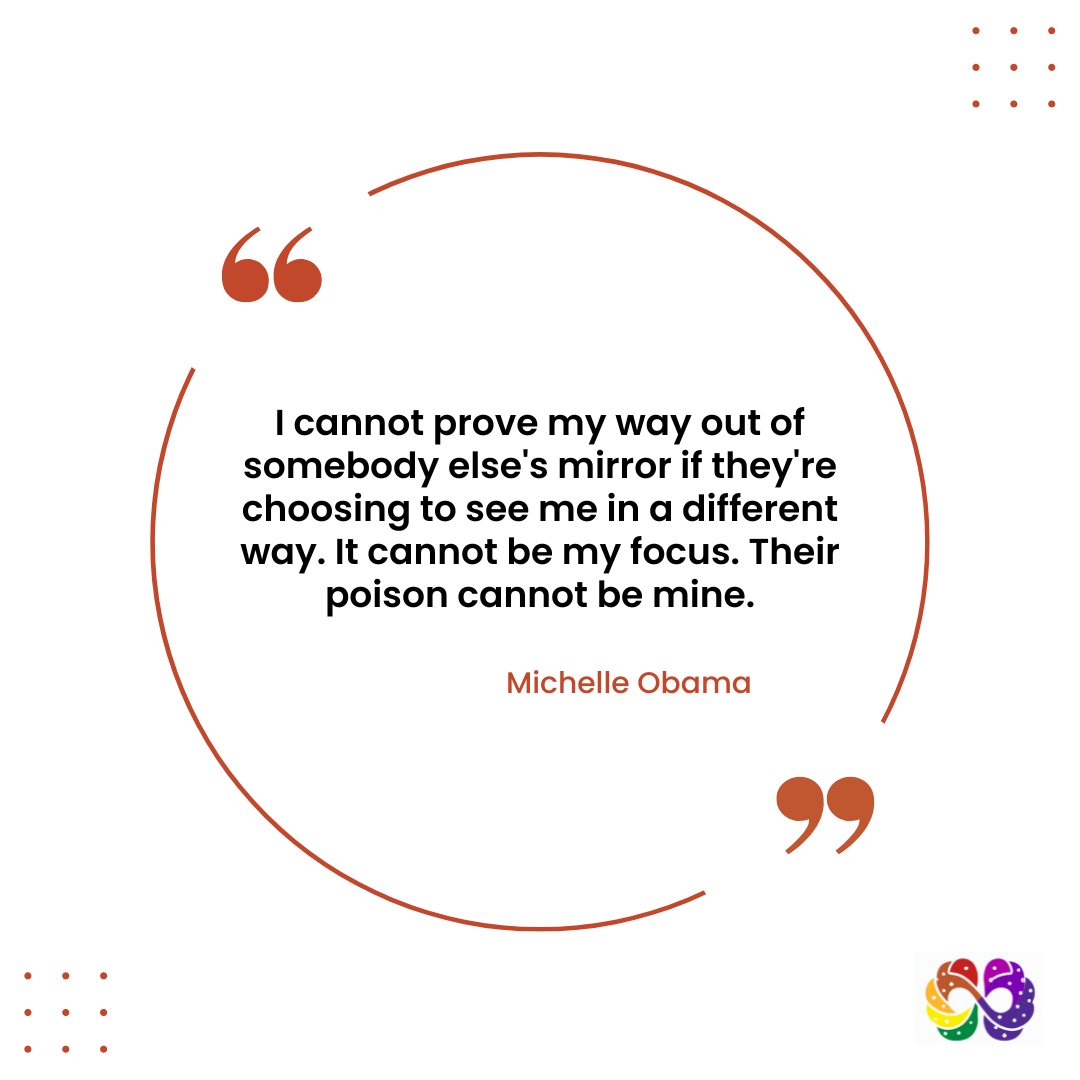
Not every friendship survives difficulty.
Radical Acceptance
Knowing when to let go is its own skill. The most self-respecting thing you can do is stop working to maintain something that only one of you is trying to keep.
Most neurotypicals will not:
- Bother to learn new terms and definitions
- Keep using inclusion frameworks when they start being inconvenient
- Think accessible boundaries apply to them
- Engage in any meaningful perspective-taking
These are not your people. Do not waste your time with them.
We can’t expect neurotypicals to:
- Understand as much about us as we understand them
- Relate to our experiences
- Know what’s respectful or appropriate
Some neurotypicals will:
- Have good intentions but the wrong execution
- Struggle to wrap their heads around how you work
- They might get overwhelmed and need to regroup
- Iterate until something works
In some rare cases they will have significant exposure to disability through work, similar friends, or family
If they have trauma, they’ll take responsibility for it and do the work to heal it. They’ll do the work today and learn the social skills it takes to live in a world where neurotypicals and neurodivergents can share space. If they can’t do it today, they’ll choose to build space for it tomorrow (tomorrow not to be interpreted literally).
Someone who understands the difference between who you are and how your brain works won’t treat you like disposable tissues or the first pancake you flip.
Look for these people. The kind of person that’s interested in learning is the kind of person that you want.
Worth It When
But some friendships do survive difficulty, and not just the surface-level kind. The ones worth keeping often went somewhere hard and found a way back, not by pretending the hard thing didn’t happen, but by both people deciding the relationship mattered more than the rupture.
Repair is possible. It requires both people to value the relationship enough to make space for it, at the same time, or by looping back when everyone is ready.
Remember
You are not too much. You are not broken. You are not someone who needs to be fixed before you are allowed to have friends.
You are someone who processes the world differently, which means you need friends with enough self-actualization to meet you where you are. Those people exist. Some of them are neurodivergent. Some are neurotypical people who have done enough of their own work to know that different is not less, and not just when it comes to certain groups.
The goal is never to fit in. It is to belong, and belonging, unlike fitting in, does not require you to disappear.
We end up with the friends we believe we deserve.
Believe accordingly.