ND Upgrade - Personal
  • Tell My Loved Ones
  • Our Toolbox
  • Interpersonal 🚧
  1. - The Size of Problems
  • Tell My Loved Ones About…

  • - Acting More Neurodivergent
  • - Autism
  • [ND Kids]

  • - Growing My ND Identity
  • - Choosing A Speech & Language Therapist
  • - Understand Meltdowns
  • - Good Learning
  • - The Size of Problems
  • - Behaviour Charts
  • - Social Stories
  • - Screen Time
Neurodivergent Upgrade

The Size of Problems
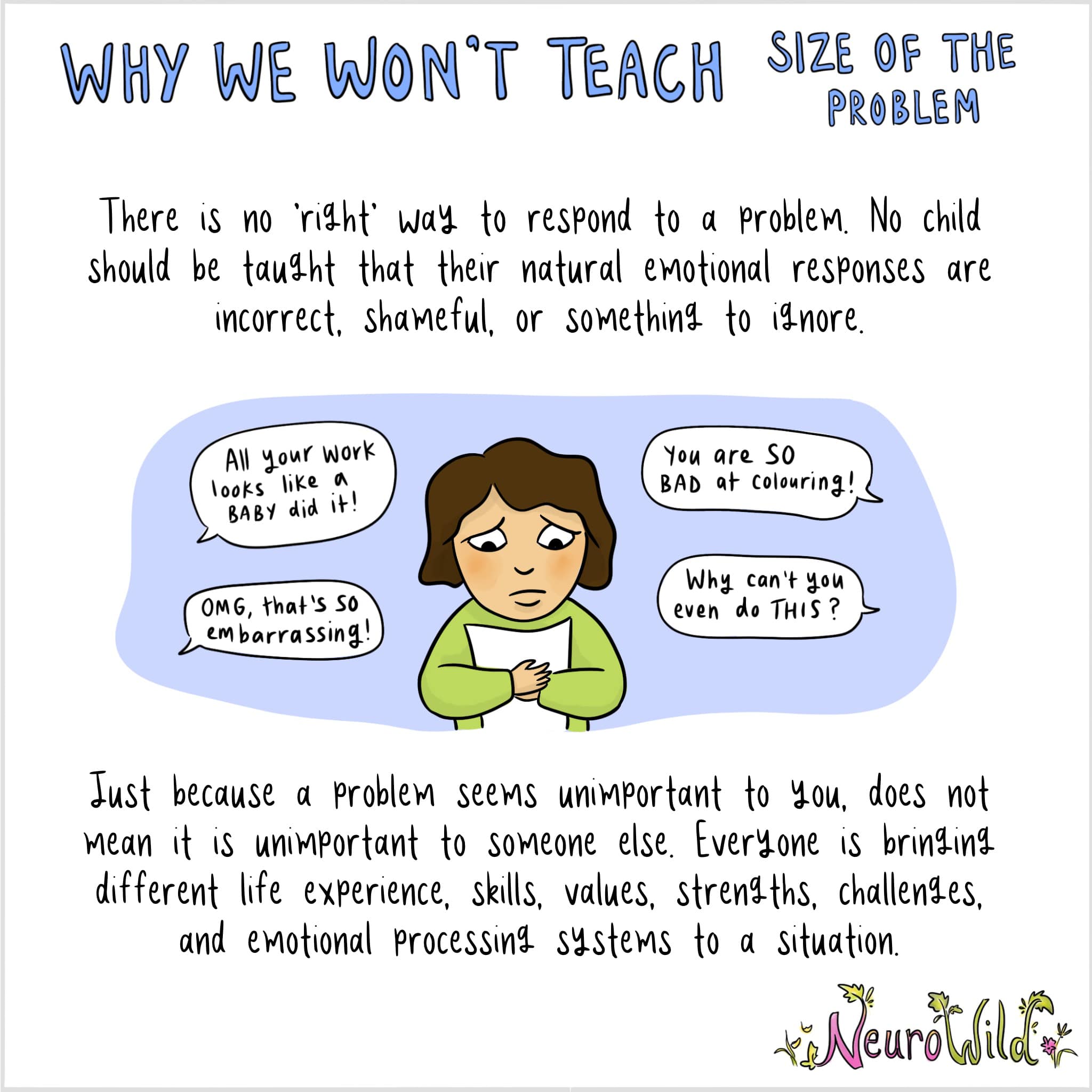
NeuroWild panel. Blue hand-lettered title 'WHY WE WON'T TEACH SIZE OF THE PROBLEM'. Text: 'There is no 'right' way to respond to a problem. No child should be taught that their natural emotional responses are incorrect, shameful, or something to ignore.' A sad child with brown hair and a green sweater holds a paper to their chest, surrounded by four speech bubbles: 'All your work looks like a BABY did it!', 'You are SO BAD at colouring!', 'OMG, that's so embarrassing!', 'Why can't you even do THIS?' Text below: 'Just because a problem seems unimportant to you, does not mean it is unimportant to someone else. Everyone is bringing different life experience, skills, values, strengths, challenges, and emotional processing systems to a situation.' The NeuroWild logo is at the bottom right.

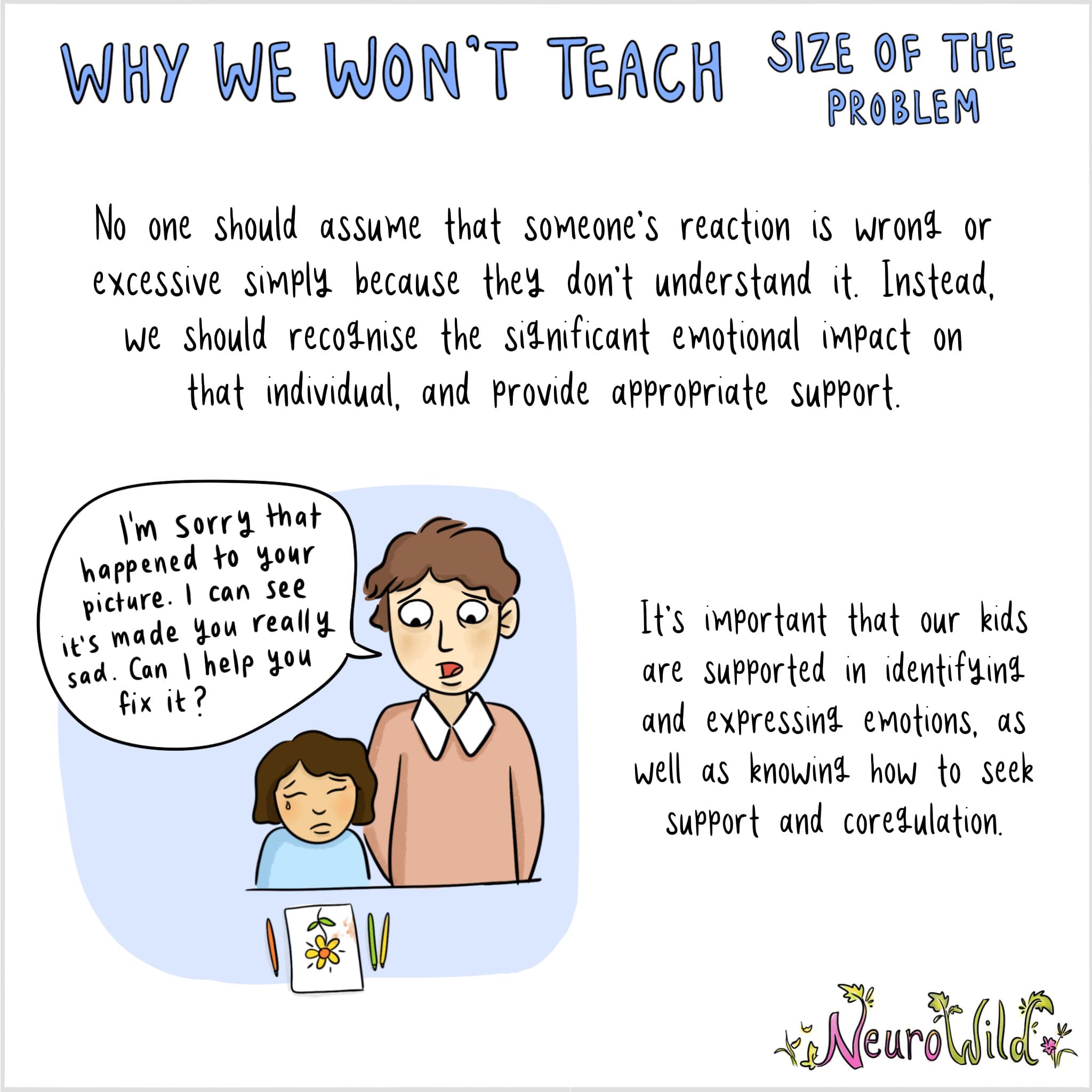
NeuroWild panel. Blue hand-lettered title 'WHY WE WON'T TEACH SIZE OF THE PROBLEM'. Text: 'No one should assume that someone's reaction is wrong or excessive simply because they don't understand it. Instead, we should recognise the significant emotional impact on that individual, and provide appropriate support.' A worried adult in a pink sweater with a white collar stands beside a crying child with brown hair and a blue top, with a drawing of a flower with a smudge on the table in front of them. Speech bubble: 'I'm sorry that happened to your picture. I can see it's made you really sad. Can I help you fix it?' Text at right: 'It's important that our kids are supported in identifying and expressing emotions, as well as knowing how to seek support and coregulation.' The NeuroWild logo is at the bottom right.

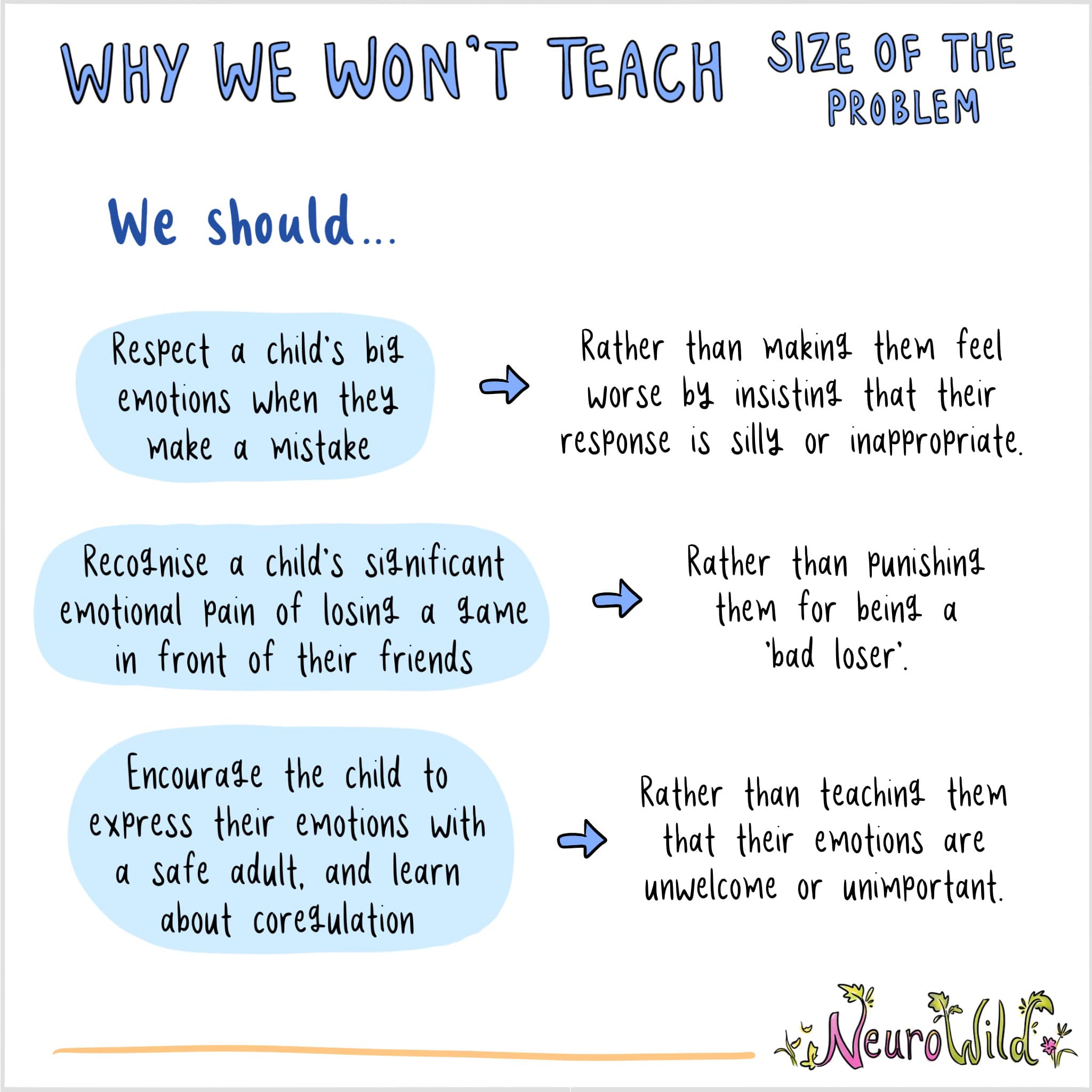
NeuroWild panel. Blue hand-lettered title 'WHY WE WON'T TEACH SIZE OF THE PROBLEM'. Heading 'We should...' followed by three pairs of text. Light blue blob 'Respect a child's big emotions when they make a mistake' with an arrow to 'Rather than making them feel worse by insisting that their response is silly or inappropriate.' Blob 'Recognise a child's significant emotional pain of losing a game in front of their friends' with an arrow to 'Rather than punishing them for being a 'bad loser'.' Blob 'Encourage the child to express their emotions with a safe adult, and learn about coregulation' with an arrow to 'Rather than teaching them that their emotions are unwelcome or unimportant.' The NeuroWild logo is at the bottom right.

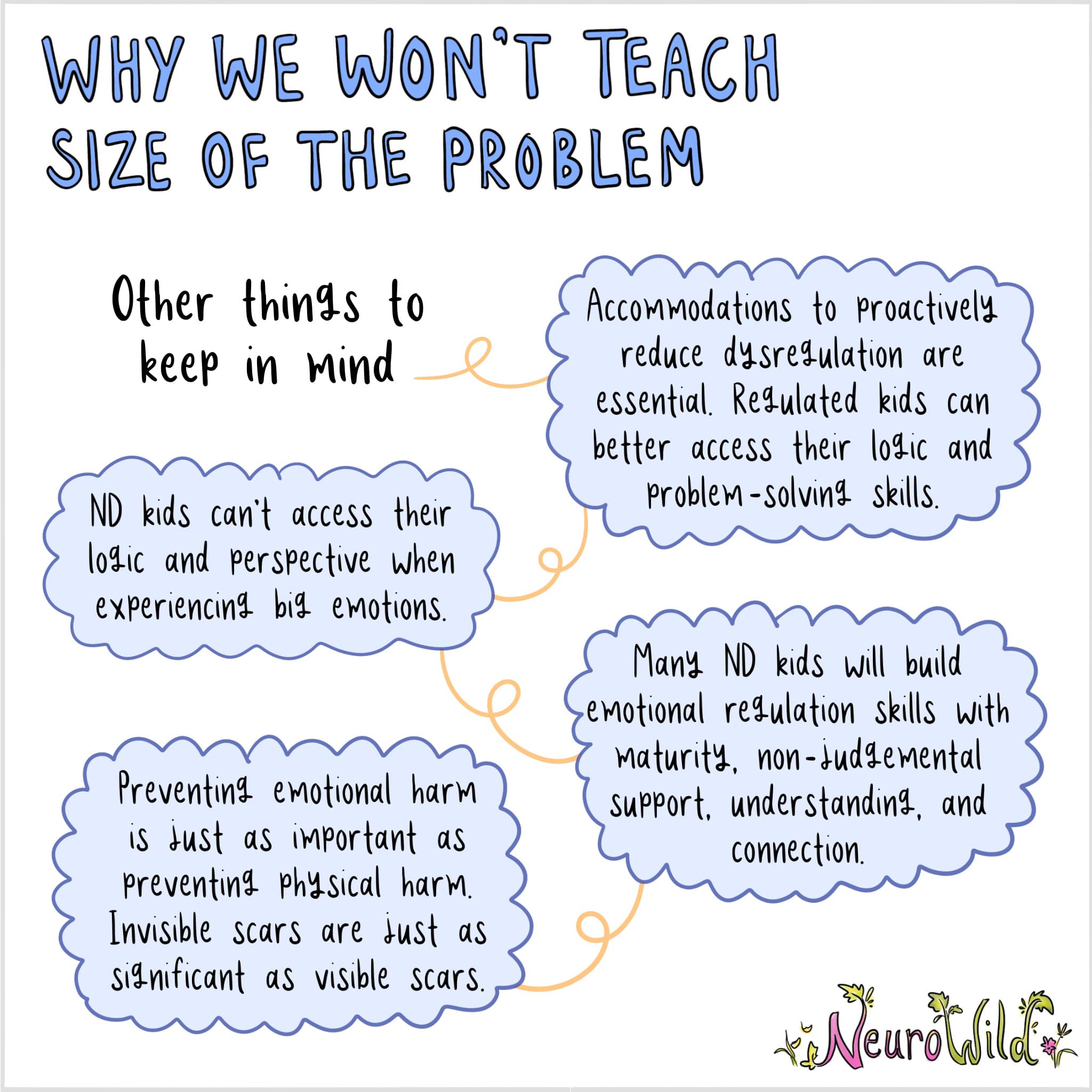
NeuroWild panel. Large blue hand-lettered title 'WHY WE WON'T TEACH SIZE OF THE PROBLEM'. Heading 'Other things to keep in mind' with a curly line linking four cloud-shaped blue blobs: 'Accommodations to proactively reduce dysregulation are essential. Regulated kids can better access their logic and problem-solving skills.' 'ND kids can't access their logic and perspective when experiencing big emotions.' 'Many ND kids will build emotional regulation skills with maturity, non-judgemental support, understanding, and connection.' 'Preventing emotional harm is just as important as preventing physical harm. Invisible scars are just as significant as visible scars.' The NeuroWild logo is at the bottom right.

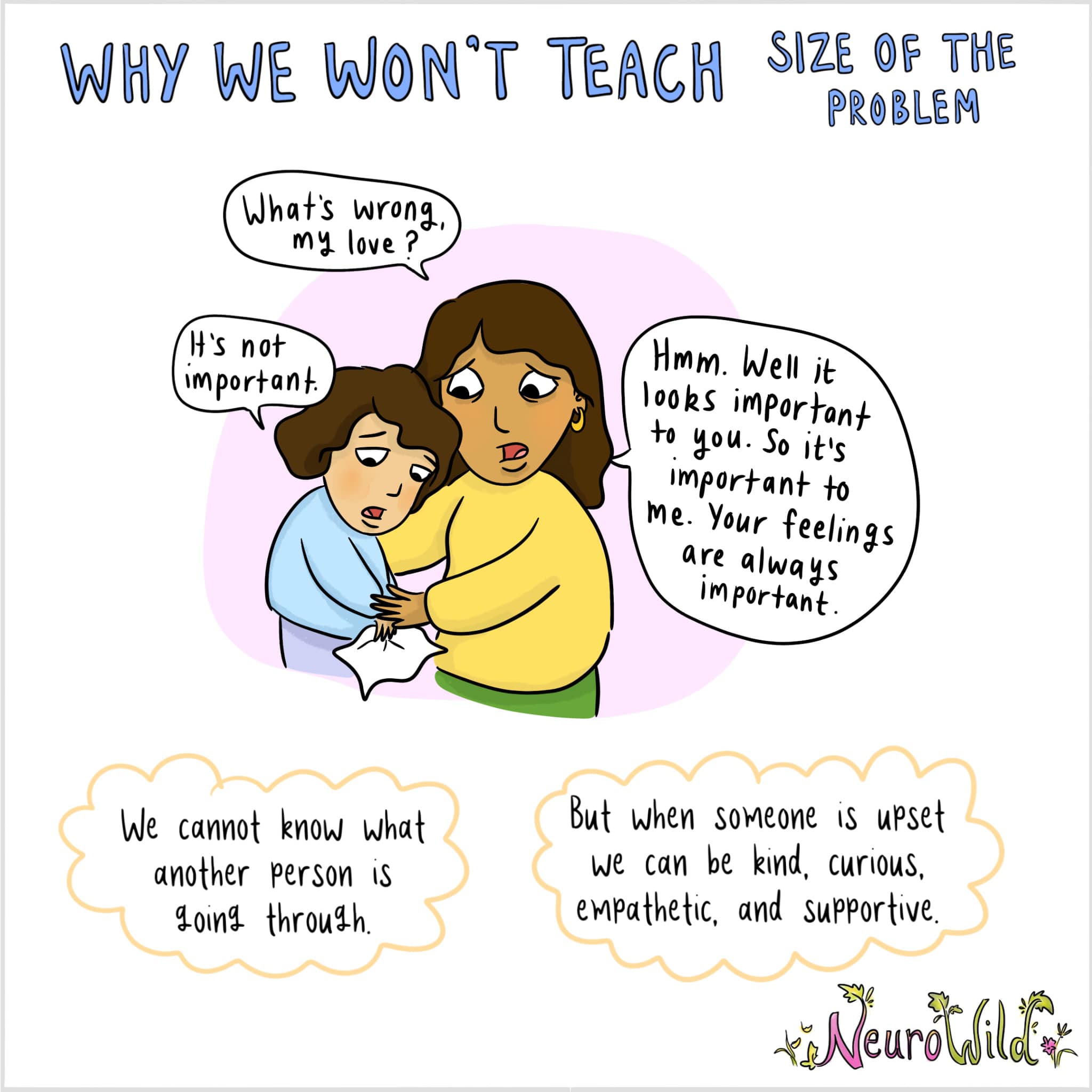
NeuroWild panel. Blue hand-lettered title 'WHY WE WON'T TEACH SIZE OF THE PROBLEM'. A parent with long brown hair, a yellow sweater and a gold earring holds a child with brown hair in a blue top who is holding a tissue. Speech bubbles: parent 'What's wrong, my love?'; child 'It's not important.'; parent 'Hmm. Well it looks important to you. So it's important to me. Your feelings are always important.' Two cream cloud captions at the bottom: 'We cannot know what another person is going through.' and 'But when someone is upset we can be kind, curious, empathetic, and supportive.' The NeuroWild logo is at the bottom right.

About The Artist

NeuroWild is a comic strip series created by Emily Hammond. Emily is a speech pathologist with ADHD and Autism herself and a proud mother to neurodivergent children. Click here to learn more about the artists we promote and how to support their work.

© 2026 Neurodivergent Upgrade All Rights Reserved

Cookie Preferences