ND Upgrade - Personal
  • Tell My Loved Ones
  • Our Toolbox
  • Interpersonal 🚧
  1. - Social Stories
  • Tell My Loved Ones About…

  • - Acting More Neurodivergent
  • - Autism
  • [ND Kids]

  • - Growing My ND Identity
  • - Choosing A Speech & Language Therapist
  • - Understand Meltdowns
  • - Good Learning
  • - The Size of Problems
  • - Behaviour Charts
  • - Social Stories
  • - Screen Time
Neurodivergent Upgrade

Social Stories

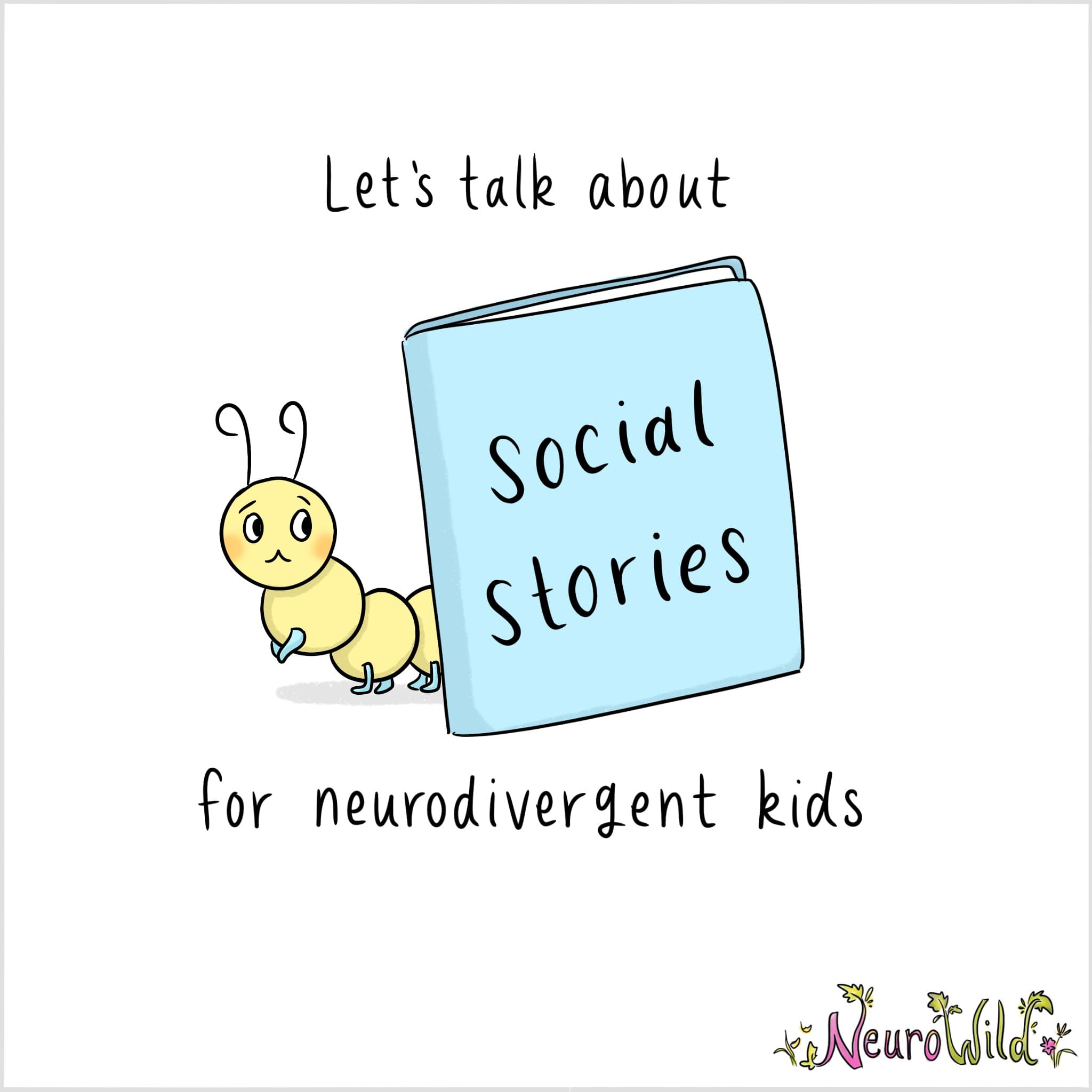
NeuroWild title panel. A small yellow caterpillar with antennae peeks out from behind a large light blue book with the title 'Social stories'. Text above: 'Let's talk about'. Text below: 'for neurodivergent kids'. The NeuroWild logo is at the bottom right.

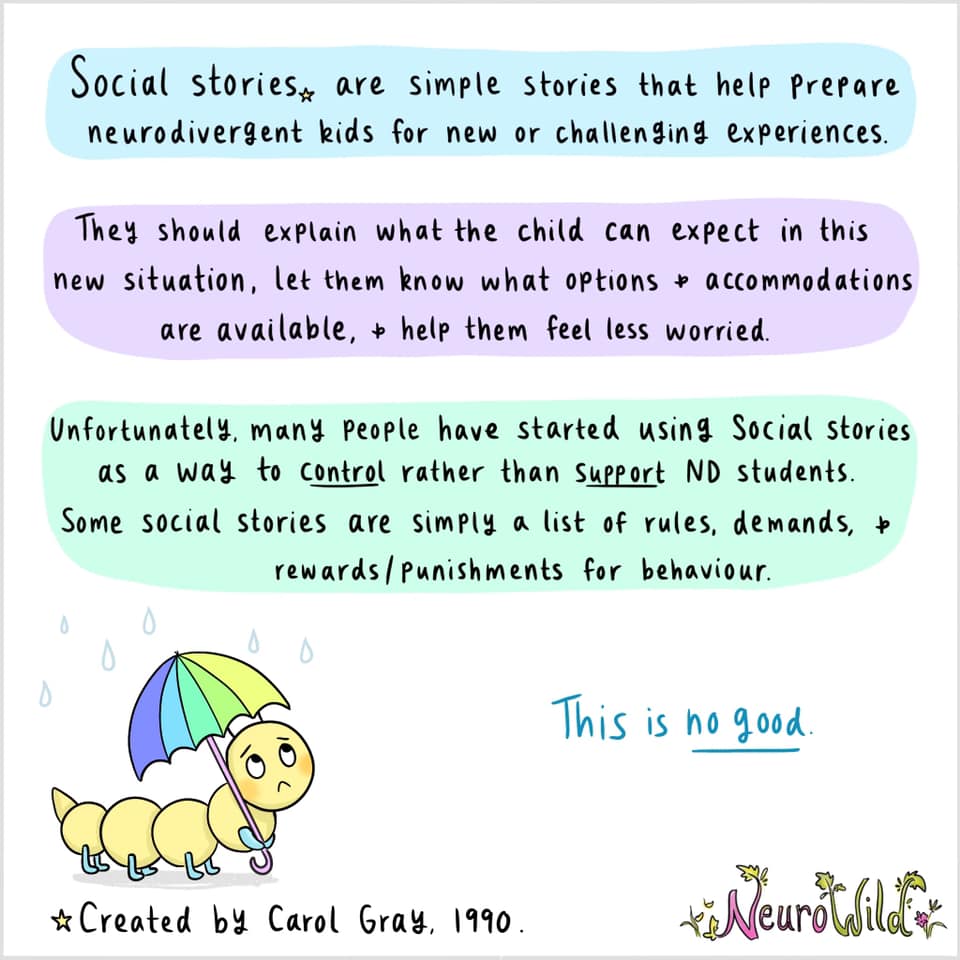
NeuroWild panel. Three colored blobs of text: 'Social stories* are simple stories that help prepare neurodivergent kids for new or challenging experiences.' 'They should explain what the child can expect in this new situation, let them know what options & accommodations are available, & help them feel less worried.' 'Unfortunately, many people have started using Social stories as a way to control rather than support ND students. Some social stories are simply a list of rules, demands, & rewards/punishments for behaviour.' A worried yellow caterpillar holds a rainbow umbrella in the rain beside the words 'This is no good.' Footnote: '* Created by Carol Gray, 1990.' The NeuroWild logo is at the bottom right.

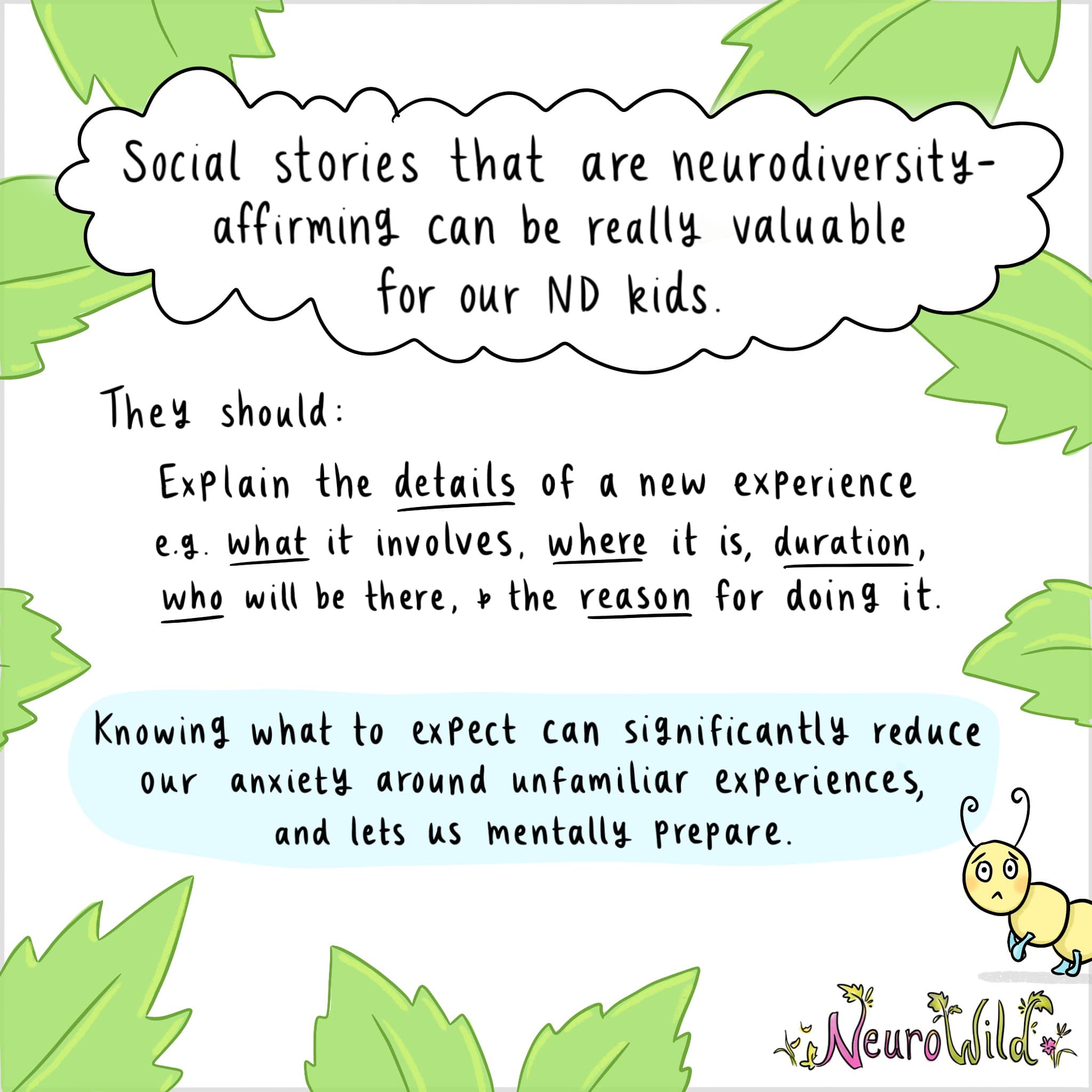
NeuroWild panel framed by large green leaves. A cloud reads: 'Social stories that are neurodiversity-affirming can be really valuable for our ND kids.' Text: 'They should: Explain the details of a new experience e.g. what it involves, where it is, duration, who will be there, & the reason for doing it.' with 'details', 'what', 'where', 'duration', 'who' and 'reason' underlined. Light blue blob: 'Knowing what to expect can significantly reduce our anxiety around unfamiliar experiences, and lets us mentally prepare.' A worried yellow caterpillar peeks in at the lower right. The NeuroWild logo is at the bottom right.

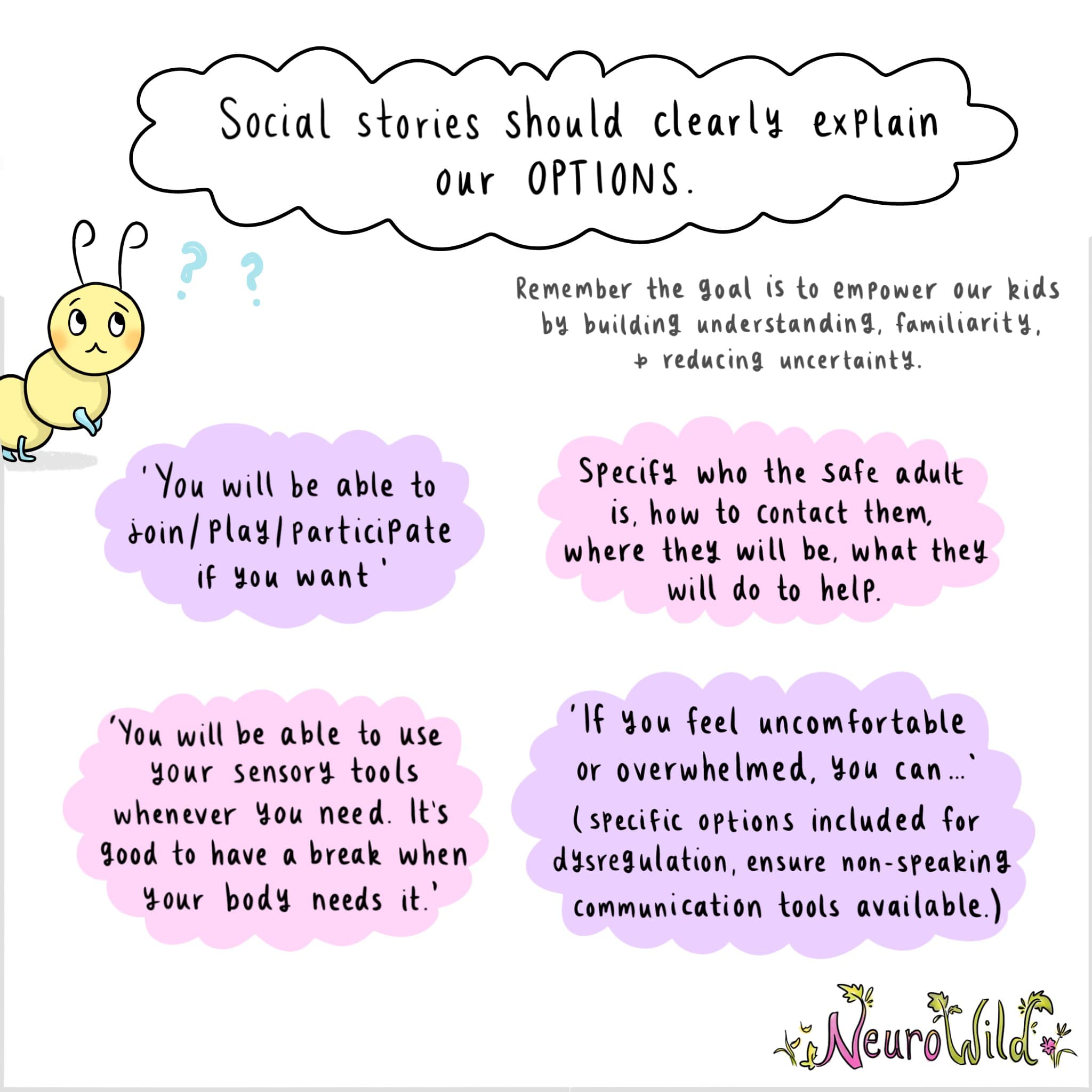
NeuroWild panel. A cloud reads: 'Social stories should clearly explain our OPTIONS.' A yellow caterpillar with question marks above it looks up at the left. Gray text: 'Remember the goal is to empower our kids by building understanding, familiarity, & reducing uncertainty.' Four blobs: ''You will be able to join/play/participate if you want''; 'Specify who the safe adult is, how to contact them, where they will be, what they will do to help.'; ''You will be able to use your sensory tools whenever you need. It's good to have a break when your body needs it.''; ''If you feel uncomfortable or overwhelmed, you can...' (specific options included for dysregulation, ensure non-speaking communication tools available.)' The NeuroWild logo is at the bottom right.

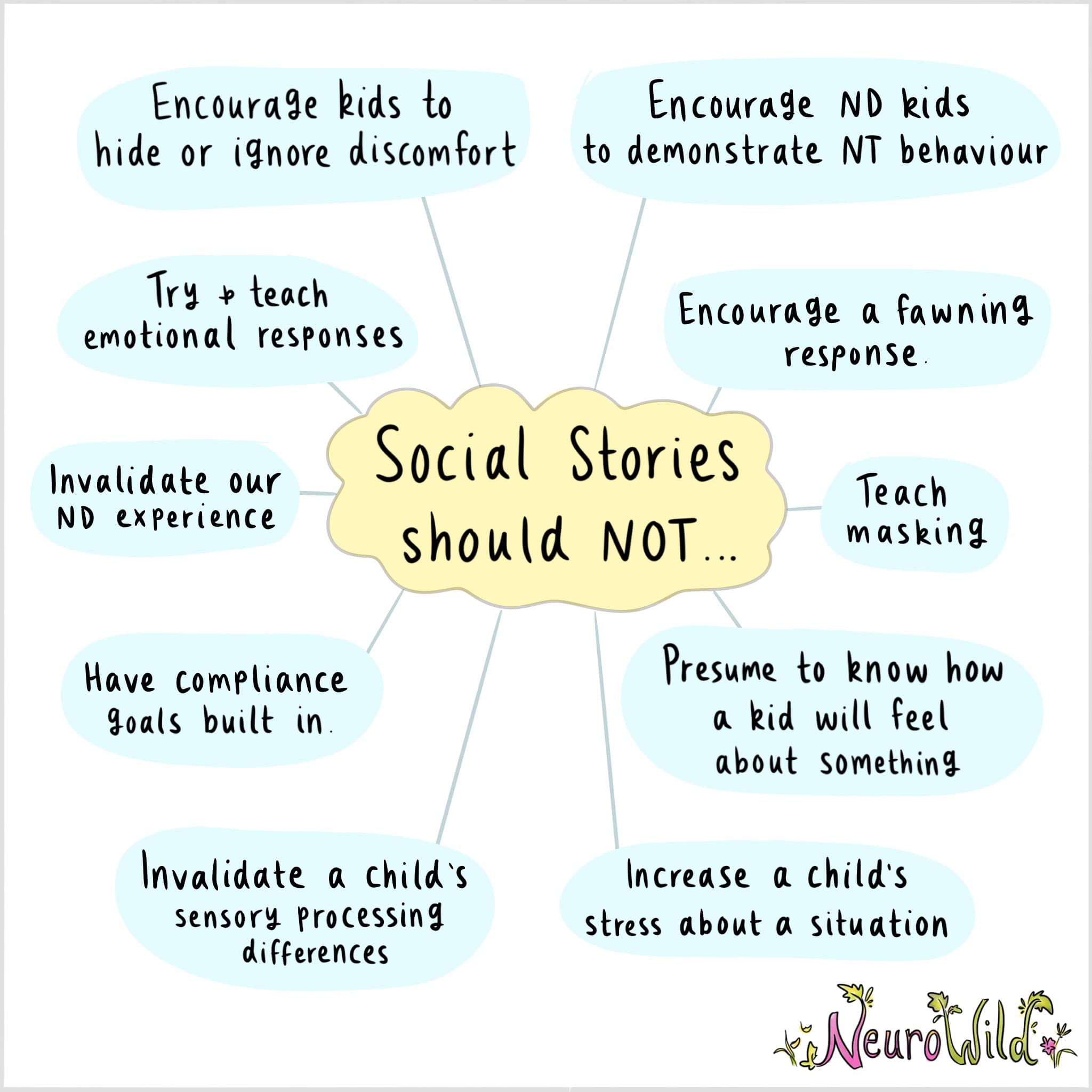
NeuroWild mind-map panel. A yellow cloud in the center reads 'Social Stories should NOT...' with nine light blue blobs connected to it: 'Encourage kids to hide or ignore discomfort'; 'Encourage ND kids to demonstrate NT behaviour'; 'Encourage a fawning response.'; 'Teach masking'; 'Presume to know how a kid will feel about something'; 'Increase a child's stress about a situation'; 'Invalidate a child's sensory processing differences'; 'Have compliance goals built in.'; 'Invalidate our ND experience'; 'Try & teach emotional responses'. The NeuroWild logo is at the bottom right.

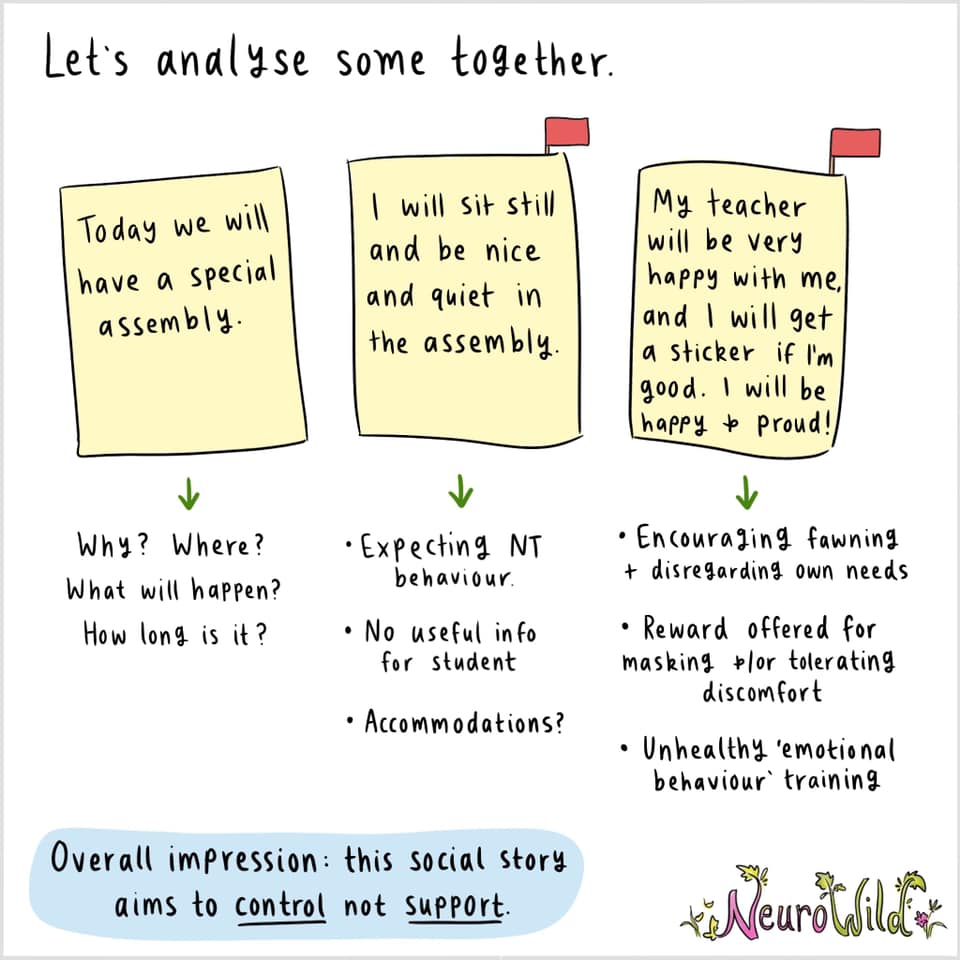
NeuroWild panel. Heading: 'Let's analyse some together.' Three yellow story cards (two with red flags) with arrows to commentary. Card 1: 'Today we will have a special assembly.' leads to 'Why? Where? What will happen? How long is it?' Card 2: 'I will sit still and be nice and quiet in the assembly.' leads to 'Expecting NT behaviour. No useful info for student. Accommodations?' Card 3: 'My teacher will be very happy with me, and I will get a sticker if I'm good. I will be happy & proud!' leads to 'Encouraging fawning + disregarding own needs. Reward offered for masking +/or tolerating discomfort. Unhealthy 'emotional behaviour' training'. Blue box: 'Overall impression: this social story aims to control not support.' with 'control' and 'support' underlined. The NeuroWild logo is at the bottom right.

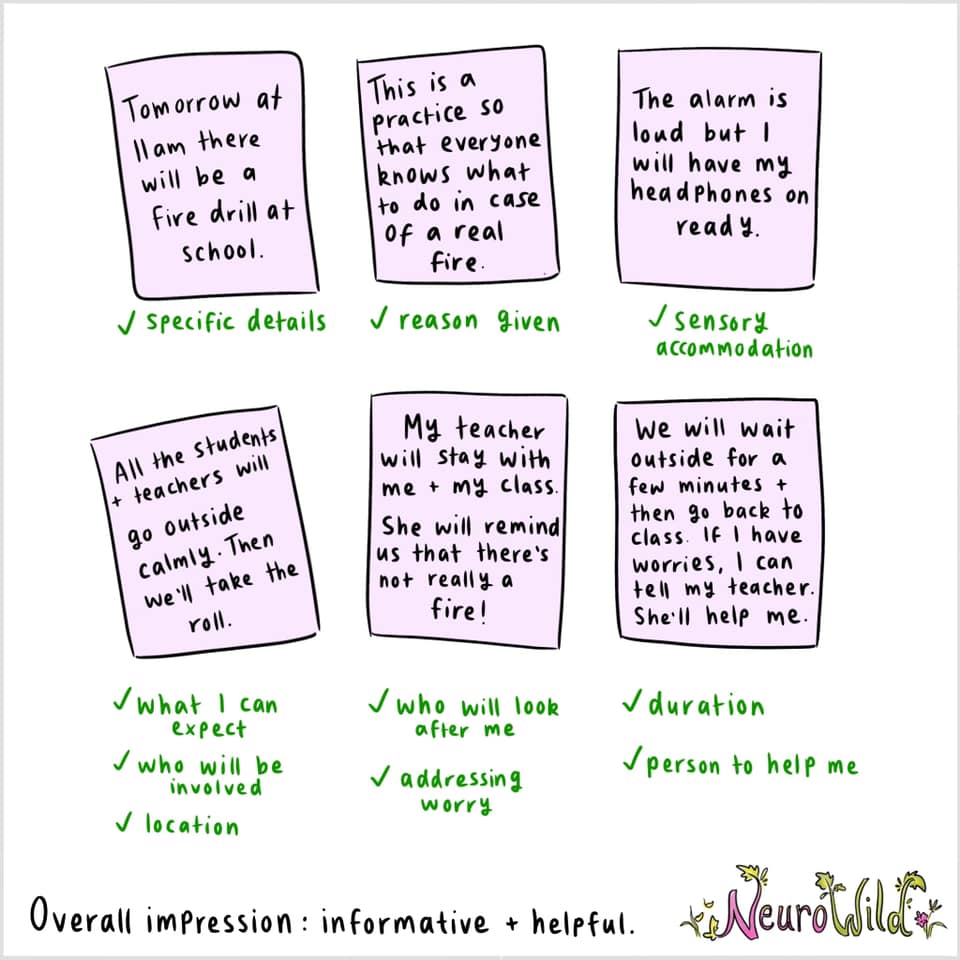
NeuroWild panel. Six lilac story cards, each with a green checkmark note. 'Tomorrow at 11am there will be a fire drill at school.' (specific details). 'This is a practice so that everyone knows what to do in case of a real fire.' (reason given). 'The alarm is loud but I will have my headphones on ready.' (sensory accommodation). 'All the students + teachers will go outside calmly. Then we'll take the roll.' (what I can expect; who will be involved; location). 'My teacher will stay with me + my class. She will remind us that there's not really a fire!' (who will look after me; addressing worry). 'We will wait outside for a few minutes + then go back to class. If I have worries, I can tell my teacher. She'll help me.' (duration; person to help me). Bottom text: 'Overall impression: informative + helpful.' The NeuroWild logo is at the bottom right.

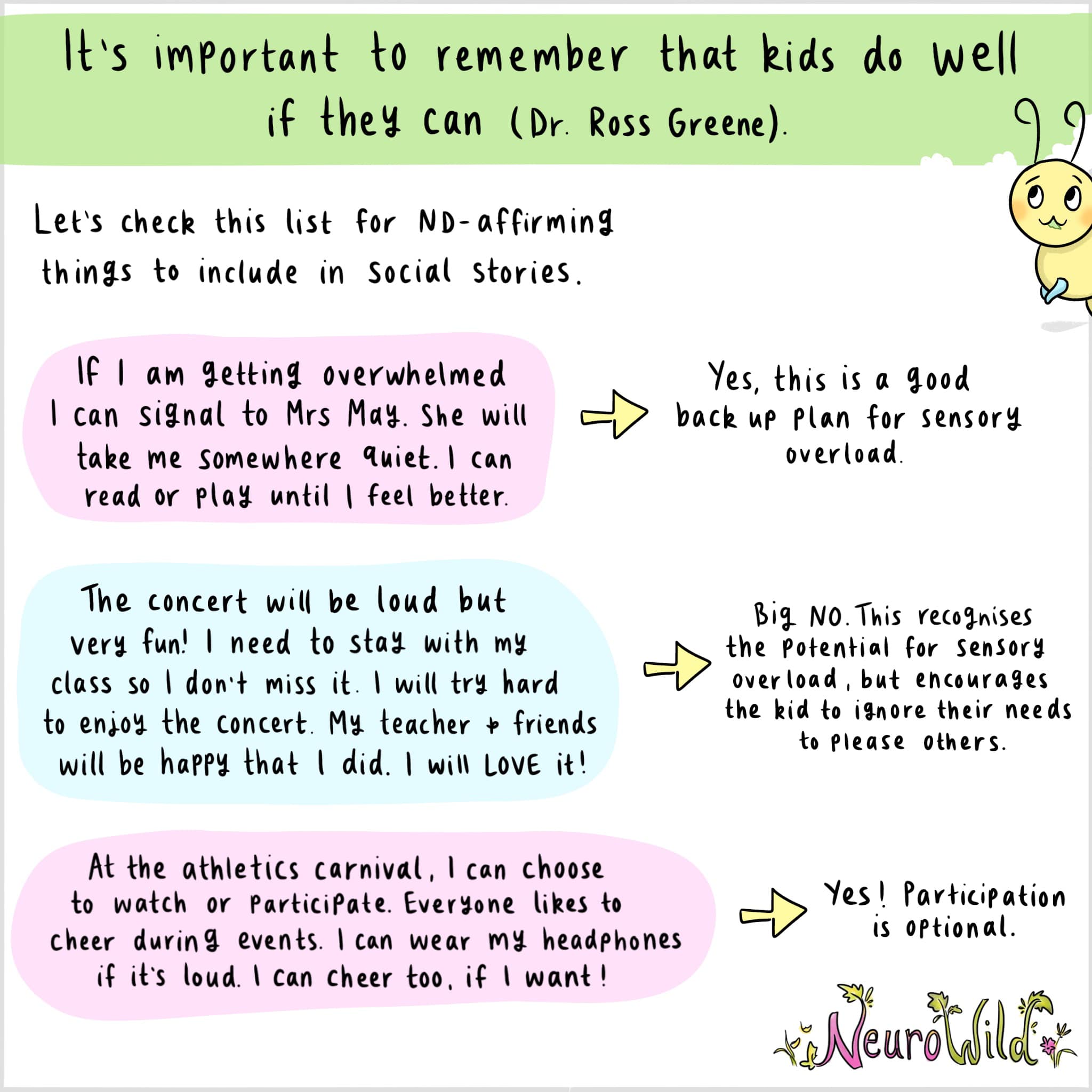
NeuroWild panel. A green banner reads: 'It's important to remember that kids do well if they can (Dr. Ross Greene).' Text: 'Let's check this list for ND-affirming things to include in social stories.' Three examples with arrows. 'If I am getting overwhelmed I can signal to Mrs May. She will take me somewhere quiet. I can read or play until I feel better.' leads to 'Yes, this is a good back up plan for sensory overload.' 'The concert will be loud but very fun! I need to stay with my class so I don't miss it. I will try hard to enjoy the concert. My teacher + friends will be happy that I did. I will LOVE it!' leads to 'Big NO. This recognises the potential for sensory overload, but encourages the kid to ignore their needs to please others.' 'At the athletics carnival, I can choose to watch or participate. Everyone likes to cheer during events. I can wear my headphones if it's loud. I can cheer too, if I want!' leads to 'Yes! Participation is optional.' A yellow caterpillar peeks in at the top right. The NeuroWild logo is at the bottom right.

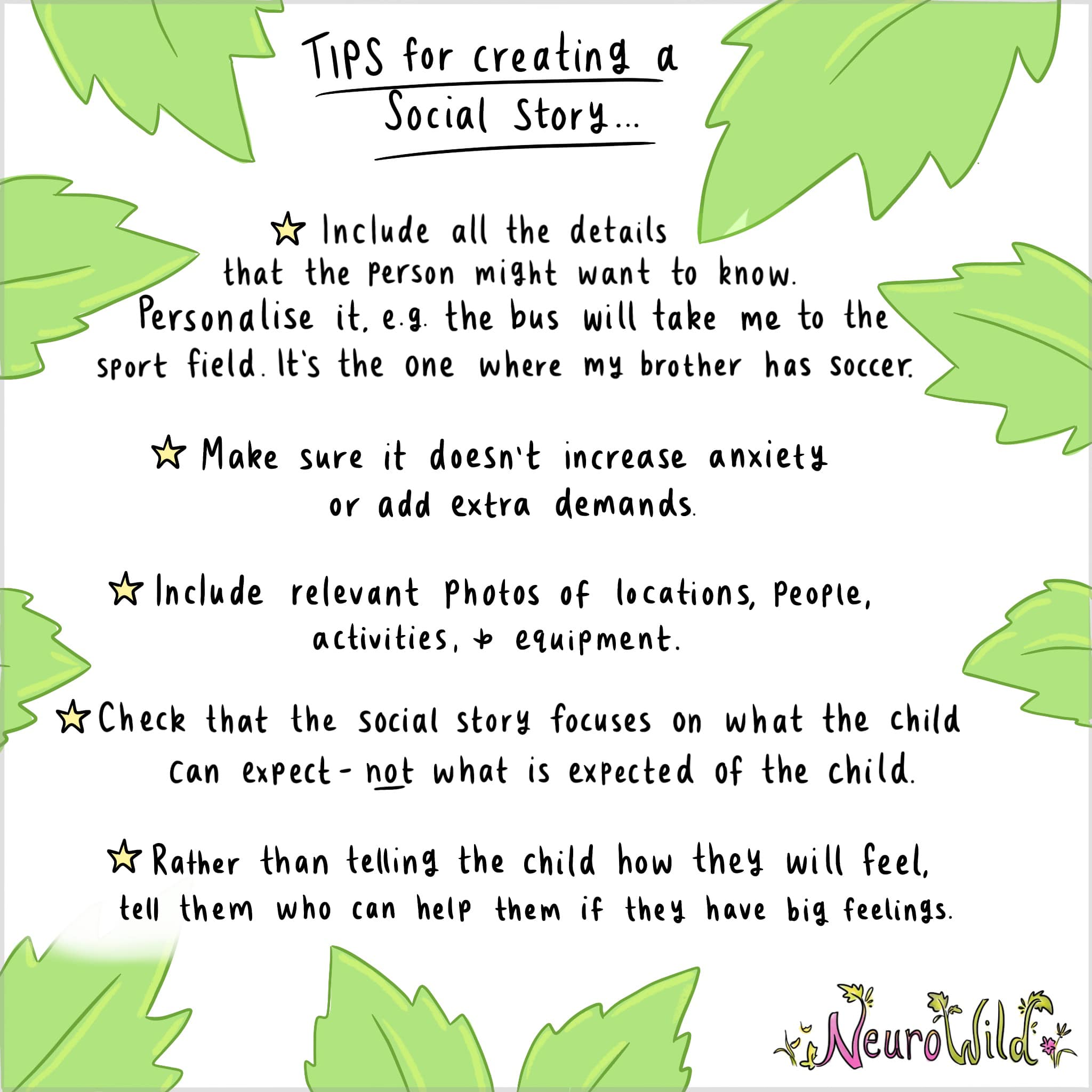
NeuroWild panel framed by large green leaves. Title: 'TIPS for creating a Social Story...' Five starred tips: 'Include all the details that the person might want to know. Personalise it, e.g. the bus will take me to the sport field. It's the one where my brother has soccer.' 'Make sure it doesn't increase anxiety or add extra demands.' 'Include relevant photos of locations, people, activities, & equipment.' 'Check that the social story focuses on what the child can expect- not what is expected of the child.' 'Rather than telling the child how they will feel, tell them who can help them if they have big feelings.' The NeuroWild logo is at the bottom right.

About The Artist

NeuroWild is a comic strip series created by Emily Hammond. Emily is a speech pathologist with ADHD and Autism herself and a proud mother to neurodivergent children. Click here to learn more about the artists we promote and how to support their work.

© 2026 Neurodivergent Upgrade All Rights Reserved

Cookie Preferences